
- Key Takeaways
- Plan Saskatchewan Oilfield Rentals
- Mitigate Seasonal Ground Risks
- Audit True Equipment Economics
- Compare rental costs against potential downtime and lost oil production to determine true economic impact.
- Evaluate the total cost of ownership, including delivery, setup, maintenance, and fuel for each equipment rental.
- Track rental durations and return dates to avoid unnecessary extension fees.
- Use a spreadsheet to analyze and optimize equipment rental budgets for oil and gas projects.
- Select Core Production Packages
- Streamline Multi-Vendor Delivery Logistics
- Consolidate equipment orders to minimize the number of vendors and simplify delivery coordination.
- Assign a single point of contact to oversee all equipment rentals and logistics.
- Create a master delivery schedule to track arrivals from multiple vendors and avoid conflicts.
- Use digital tools or software to manage and communicate logistics updates in real time.
- Leverage Reliable Regional Support
- Conclusion
- Frequently Asked Questions
- What should I consider first when planning Saskatchewan oilfield rentals?
- How do seasonal ground conditions affect oilfield rentals in Saskatchewan?
- How can I tell if renting equipment is more cost-effective than buying?
- Which core rental packages are most common for Saskatchewan production sites?
- How can I streamline logistics when using multiple oilfield rental vendors?
- Why is using a regional Saskatchewan rental provider important?
- What support should I expect from a reputable Saskatchewan oilfield rental company?
Key Takeaways
- Schedule Saskatchewan oilfield rentals with your project requirements, site conditions, and timelines in mind to avoid any delay and minimize unexpected costs. Verify all rented equipment is oil and gas standards compliant and that it aligns with local regulations before it arrives onsite.
- Verify road access, seasonal limitations and weight restrictions for remote sites in order to confirm that heavy equipment can be transported to locations safely. Employ precise mapping and obvious delivery directions so suppliers can locate specific drop-off locations, even in remote areas.
- Equipment supply: Match specs to well demands and infrastructure for compatibility problems. Ask for spec sheets and use checklists to shop options to capacity, safety features, and regulation.
- Co-ordinate delivery, fuel supply and contingency plans together to keep operations up and running. Get your team ready to accept, inspect and operate rented equipment and establish transparent protocols in case of emergency or weather-related incidents.
- Consider the complete economics of each rental — delivery, maintenance, fuel, and downtime. Keep tabs on rental lengths and leverage low-tech solutions, like spreadsheets, to maximize budgets and prevent extension or standby fees.
- Work with trusted Saskatchewan-based rental experts that know the local conditions and regulations. Take advantage of their local expertise, 24/7 service and production bundles to simplify logistics from drilling to production across the province.
Saskatchewan oilfield rentals are rental services that offer temporary rental of equipment, tools, and site support utilized in drilling, production, and maintenance throughout the province’s energy fields. Saskatchewan oilfield rentals include tanks, generators, light towers, access mats, and surface equipment. Companies rent to keep costs variable and projects on track. Rentals are a critical factor at remote work sites, where quick access to safe and reliable equipment can reduce downtime and minimize transportation requirements. Most providers provide delivery, setup, and basic field support, so that small and mid-sized operators can stay lean. In the following sections, we turn our attention to typical rental categories, safety and compliance concerns, and how to compare local rental companies.
Plan Saskatchewan Oilfield Rentals
Planning Saskatchewan oilfield rentals is about getting the perfect combination of equipment, scheduling, and logistics. Every decision must accommodate the well’s potential, the lease configuration, and the proximity to a major center like Swift Current or Estevan.
1. Site Accessibility
 Begin by looking at truck access to the site in all seasons. Gravel roads that are passable in dry weather can become soft during spring thaw, so a rig mat delivery that is straightforward in August could be difficult in March. Request current road reports from local municipalities and review Saskatchewan’s seasonal trucking weight restrictions before confirming hauling dates and routes.
Weight and width limits are as important as distance. A 20-ton vacuum truck or a tank convoy could require different pathways if there are bridge limits or posted spring bans. Blowing snow or ice can slow lowboys hauling mud tanks or generators in winter, so add buffer time to your move schedule.
Confirm load-out points and last-mile turns with maps or GPS pins. A brief drone video or photos from a past job assist drivers in locating the right lease road, which reduces missed turns, stuck units, and wasted fuel.
2. Equipment Specifications
Match gear to the well and formation, not just a generic checklist. A deep horizontal well may require higher-capacity mud tanks, larger shakers, and higher-output heaters than a shallow vertical well located adjacent to existing infrastructure.
Request spec sheets from vendors for rental generators and light towers, tanks, and pumps. Verify power output, tank volume, pressure ratings, and flame arrestors or emergency shutoff features. Compare those specifications with your drilling schedule, electrical demands, and pad configuration.
Maintain an easy checklist by equipment type. For example, for generators: kW rating, voltage, fuel type, noise level, and plug configuration. This makes rentals uniform across sites and helps new crew members make faster and safer decisions.
3. Delivery Coordination
Factor in long hauls between depots and leases. A 300 km run to a remote pad impacts start times more than a short move near Estevan, so secure delivery dates that align with rig-up or frac timelines.
Communicate definitive delivery windows and on-site contact information with vendors. Request tracking links or status messages, so field personnel are aware if a tank set or flare stack is two hours out or still sitting in the yard. Have someone on site prepared to direct drivers, sign documents, and inspect for any damage prior to the truck departing.
4. Fuel Needs
Estimate fuel use for each unit: generators, heaters, light towers, and pumps. For instance, a 200 kW generator can burn dozens of liters per hour on load and it all adds up quickly on a day-long shift.
Establish a reliable fuel supply, either through a bulk tank on location or truck delivery. Monitor dip readings or meter logs to identify burn rates that exceed the plan early and adjust order volumes.
Maintain an easy fuel table with unit ID, daily usage, last fill, and next delivery date. This avoids dry tanks that kill power during key steps.
5. Contingency Protocols
Plan for gear to fail, roads close, or weather turns. Work out which units to cover with your rental provider, such as a spare generator or light towers at your local yard, on standby.
Train crews to shut down, isolate and report faults on rented gear. Maintain a concise contact list with vendor emergency numbers, local mechanics and towing services that can access remote leases.
Mitigate Seasonal Ground Risks
 Saskatchewan oilfield projects operate on a tight schedule. Frozen ground, drifting snow and soft spring roads can stall or halt that work. Scheduling rentals to these shifts in ground strength and access prevents downtime, broken equipment and unnecessary hauling expenses.
Winter Deep Freeze
Saskatchewan’s winter cold can fall below –30 °C, which puts a lot of stress on engines, hydraulics and electrical systems. Rental options require cold-weather packages, including block heaters, low-temperature fluids, heavy-duty batteries and enclosed control panels. Listing whether pumps, light towers and compressors are rated for these temperatures aids in eliminating cold-start failures and daily troubleshooting.
Pre-winter preventative work pays off. Get ahead of the first hard freeze with scheduled checks of heaters, generators, fuel filters and glow plugs. Verify rental units are winter-grade diesel, test battery capacity, and ensure spare filters are on-site so crews don’t chase small parts in bad weather.
Frozen lines can shut down an otherwise great setup. Protect exposed water, fuel and chemical lines with heat trace and adequate jacketing around manifolds, storage tanks and transfer hoses. When it comes to tanks, seek out rental units that have built-in heat coils or external heater hookups so fluids remain within appropriate viscosity limits.
Access is a major concern. Deep snow and drifting can impass lease roads and rig sites overnight. Establish defined snow mitigation policies such as who’s contractor, emergency access walkways and where to place snow fences and wind breaks. Schedule rentals for skid steers, plow trucks and loaders in advance. Don’t wait until a blizzard hits.
Spring Breakup Thaw
In the spring breakup, when the frost comes out of the ground, lease roads and pads can become soft and unstable. Road bans and load limits tend to present themselves on short notice, so anticipate slower and lighter hauling during this window.
When the surface turns to mud, elevated heavy gear can sink, tilt or damage buried utilities. Renting rig mats, crane mats, and portable roadways mitigates seasonal ground risks by spreading loads for cranes, loaders, and vacuum trucks. They safeguard ditches and wetlands adjacent to access roads.
Not all moves are worth the risk. Alleviate Seasonal Ground Hazards. Moving non-critical items like extra tanks or backup light towers later in the season reduces tows and recovery work from stuck units.
Most local municipalities and highway authorities post seasonal limitations. Remain in consistent communication with them and relay updates to your rental suppliers, so transit arrangements align with live regulations and you avoid penalties or unplanned hold-ups.
Audit True Equipment Economics
Auditing true equipment economics in Sask. Oilfield rentals means looking beyond the day rate and seeing the real cost of the project schedule, crew time, and production.
Compare rental costs against potential downtime and lost oil production to determine true economic impact.
Begin with the connection between rental price and manufacturing risk. A cheaper pump or generator that breaks down in the winter takes a well test down for 12 hours. If a well flows 120 m³ per day, a half-day stop can mean 60 m³ of lost output. Times a netback of 80 EUR per m³, and the ‘cheap’ option wastes 4,800 EUR of value, plus downtime and testing time. Compare this with the rate difference between a standard and heavy-duty unit. Most teams discover that paying 10 to 20 percent more per day for tougher equipment remains the lower-cost route after you include probable downtime. Apply this same audit to light towers, heaters, tanks, and separation equipment, not just high-ticket items.
Evaluate the total cost of ownership, including delivery, setup, maintenance, and fuel for each equipment rental.
For each rental, audit the true economics, not just the daily fee, but all the direct and indirect costs. Think delivery and pickup to remote leases, rig-up and rig-down labor, mandatory inspections, stand-by charges, and call-out fees for service. Add in energy use, as fuel or power can outrun the rental rate over a longer haul. For instance, a generator that is 10% more efficient can save thousands of liters of diesel on a three-month program, which can be worth far more than a little rate gap. For heaters and boilers, consider fuel curves at expected loads, not just nameplate ratings.
Track rental durations and return dates to avoid unnecessary extension fees.
Most projects in Saskatchewan miss by a couple of days because of weather, access or trucking queuing. When this happens, untracked rentals drift on. Audit actual equipment economics. Tag each unit to a work package so that when the task wraps, someone owns the off-rent call. For brief gigs, verify a weekly rate trumps a daily rate after you cross some number of days. On multi-well pads, shift idle units between wells to keep use high, rather than open a new rental.
Use a spreadsheet to analyze and optimize equipment rental budgets for oil and gas projects.
Just a sketchy spreadsheet can give transparent control. Create a sheet with each row representing a rental item and columns specifying supplier, unit type, rate, fuel consumption, delivery costs, setup cost, anticipated run days and downtime risk in percentage. Audit real equipment economics with formulas to automatically pull total cost per item, cost per day, and cost per unit of production supported. Add conditional formatting that flags items that exceed a target cost or time. Through a drilling season or a winter work program, filter by vendor, category, or field to see which rentals gave strong value and which caused overrun. Pull on this record in the next bid round to negotiate harder terms, push for bundled delivery, or check out different equipment types ahead of the next campaign.
Select Core Production Packages
- Drilling phase packages include rig tanks, mud tanks, transfer pumps, shale bins, light towers, flare stacks for well testing, and basic monitoring units.
- Completion phase packages include high-pressure test separators, flarestack systems, frac tanks, sand handling, flowback tanks, and choke manifolds.
- Production phase packages can include permanent or semi-permanent separators, heater treaters, storage tanks, flare or incinerator systems, chemical injection, metering skids, and burner management systems where required for the safe operation and control of applicable fired equipment.
Bundled rentals that group separators, flare stacks, tanks and meters into one package save setup time and minimize interface issues. Each package ought to comply with existing regulations for emissions, spill control and metering in Saskatchewan and meet industry-accepted standards like API and CSA so that audits or government inspections don’t bog down the project.
Surface Equipment
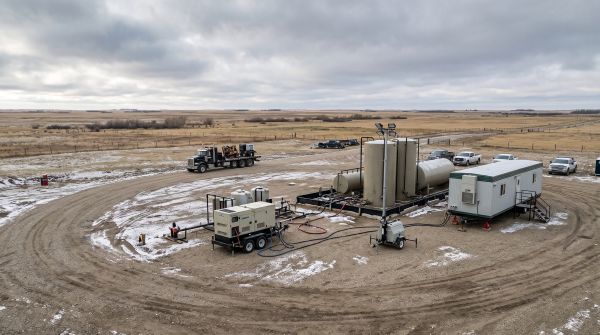
Surface equipment establishes the fundamental site design and determines how fluids flow safely on the lease. Rentals need to line up with well count, anticipated daily production in cubic metres and truck-out frequency so you don’t end up with undersized tanks or unnecessary additional units.
Key surface equipment to list and track includes:
- Crude oil storage tanks (fixed or skid‑mounted)
- Produced water tanks
- Frac / buffer tanks
- Transfer and booster pumps
- LACT or truck‑out skids
- Secondary containment berms and liners
- Spill trays and drip pans
- Hose assemblies and hard piping
- Portable generators and light towers
Validate that all tanks and pumps tie in cleanly with the existing pipeline headers, manifolds, and control systems. Mismatched flanges or voltage ratings can hold up a job, so detailed spec sheets count.
Periodic inspections in a fixed interval pattern aid in identifying corrosion, hose wear, or valve leaks early on. Easy checklists shared with the rental provider keep accountability transparent and minimize unexpected cup-downs.
Separation Systems
Separation systems to fit the anticipated oil/water/gas cut per well or pad. For a high-water-cut heavy-oil well, that might entail larger water handling and modest gas capacity. A light-oil or gas-condensate well will require high gas throughput and fine pressure control.
Test separator packages must conform to Saskatchewan’s metering and measurement regulations, such as pressure ratings, safety relief devices, and accurate flow measurement of each phase. This is crucial during clean-up and distribution trials when information purity may lead to long-term facility sizing.
Schedule tie-ins so separators coincide with upstream choke manifolds and downstream flare systems, tanks, and pipelines. Common connections and common control panels reduce setup time and assist crews in shifting packages between locations with less reconfiguration.
Continuous monitoring of temperatures, pressures and phase ratios allows operators to adjust choke settings, chemical injection and dump cycles. This might aid oil reclamation, reduce flaring time and restrict carry‑over that would overburden downstream tanks and pipelines.
Site Infrastructure
Field crews in Saskatchewan work in remote, cold and windy conditions, so site infrastructure rentals ought to shield them while remaining easy to deploy or expand. Mobile office trailers, meeting rooms, change rooms, and washrooms with holding tanks form the foundation for daily work on a pad.
Units must be insulated, sub-zero winter rated, with sound heating and safe electrical systems. Wind-resistant steps, non-slip surfaces and clear lighting reduce fundamental safety hazards in snow and ice.
Delivery and setup have to be timed with core equipment so roads, lay-down space, and power are available. This minimizes congestion when the drilling, completion, and production teams rotate through the same location.
Keeping a current list of every trailer, generator, toilet and storage unit on site assists in billing, redeployment and demobilization and reduces the likelihood of paying rental fees on abandoned units.
Streamline Multi-Vendor Delivery Logistics
Multi-vendor delivery is typical for Saskatchewan oilfield rentals, as no one site can get units and tools from a single supplier. A transparent framework for multi-vendor order, schedule, and updates reduces dead time, standby fees, and congestion on limited lease paths.
Consolidate equipment orders to minimize the number of vendors and simplify delivery coordination.
Consolidating orders begins with a comprehensive list of what the site requires for drilling, completion, and production – not ad-hoc requests. Consolidate tanks, light towers, generators, mats, and support into fewer, larger orders so the crew works with three or four vendors as opposed to ten. Fewer vendors mean fewer delivery windows to schedule, fewer sets of safety regulations to coordinate, and less risk of overlapping products arriving on different trucks. On a remote lease, this additionally eliminates heavy truck traffic and road wear on access roads. Wherever possible, select rental packages from vendors that can span multiple categories, such as surface equipment, storage, and power, rather than sharing each item across a different supplier. This generally results in more efficient invoicing and quicker problem-solving onsite.
Assign a single point of contact to oversee all equipment rentals and logistics.
One place to aggregate all rental requests, changes, and site feedback via a direct contact to one person or role. This coordinator monitors what was ordered, who is delivering, and what remains outstanding so site leaders aren’t phoning five dispatch offices to get a basic status update. In reality, this individual operates from a communal tracker, verifies that suppliers comply with site access regulations, and ensures that load dimensions and weights conform to road restrictions. If the drill schedule shifts 24 hours, the same contact shifts each vendor’s timing instead of burdening packed field supervisors.
Create a master delivery schedule to track arrivals from multiple vendors and avoid conflicts.
A master schedule shows all deliveries in one place, with dates, time windows, truck details, drivers’ contacts, and site entry notes. It indicates when high-volume moves, like rig mat deliveries, may be blocking access for smaller loads. Equipped with this perspective, the crew can spread out drop-offs, strategically plan staging zones, and maintain critical paths open for emergency services or priority units. For example, if completion equipment is due at 10:00 and waste tanks at 10:30, the schedule flags the overlap so dispatch can shift one load. It aids safety planning by simplifying briefing crews on anticipated traffic and lifting work for each shift.
Use digital tools or software to manage and communicate logistics updates in real time.
Digital tools provide real-time snapshots of where assets and trucks are, especially on those long routes in Saskatchewan. Easy solutions are shared spreadsheets in the cloud, where vendors update estimated times of arrival and delays. Even more advanced operations use logistics platforms that display GPS tracking, connect load sheets, and record site sign-ins and sign-outs. Group messaging apps have a part to play if used with strict guidelines, such as one channel per site and delivery alerts only. These real-time updates assist site leads in determining whether to keep a crane crew for an additional hour or send them free and give rental vendors the ability to modify dispatch for the next job.
Leverage Reliable Regional Support
Dependable regional support is key to effective Saskatchewan oilfield rentals, where distance, weather, and field conditions can change quickly and unexpectedly.
Take advantage of trusted local support. Local companies are already operating in crucial oilfield hubs and isolated leases, which means they understand common travel paths, staging locations and setbacks. When a heater, light tower or wellsite trailer goes down at −20 °C, a nearby yard can dispatch a replacement from a place like Estevan or Weyburn in hours, not days. Shorter hauls reduce fuel consumption, minimize transport risk, and lower standstill costs when crews and rigs sit idle and wait.
Trust local knowledge to beat regional regulations, roads and oilfields. Saskatchewan operators have to contend with provincial safety regulations, municipal bylaws, and land access conditions that vary from location to location. Local rental teams know which grid roads are weight-limited in spring, which leases require additional matting, and what clearances regulators anticipate for fuel tanks or generators. They know how clay-heavy soil, deep frost, or soft lease roads impact what kind and size of rig mats, light towers, or storage units you need to keep sites safe and stable.
Benefit from flexible rental terms and quick mobilization through trusted providers like Benoit Rentals. Work scopes in Saskatchewan frequently shift with commodity swings or weather windows. A regional provider can easily scale up with more tanks, pumps, and trailers to support a short drilling push and then scale down when the program slows without long lock-in periods. Fast marshaling from local yards gets you in sync with rentals and spud dates, completions, or shutdowns, so you only pay for units when they are really needed on location.
Tap into 24/7 support and maintenance to keep oilfield operations running smoothly in Estevan, Swift Current and beyond. Twenty-four seven support means field techs can repair pump problems overnight, replace broken heat up units before the early shift kicks off, and do preventive maintenance without interrupting production.
Conclusion
To work smart with Saskatchewan oilfield rentals, get your fundamentals in order. Align every rig, truck, tank, and light tower to an actual job and a defined time period. Check frost depth, mud risk, and road bans for every lease, not just area. Calculate the actual numbers on day rates, days idle, fuel, haul fees, and more, not just the estimate.
Tie core packages to your lift plan, fluid plan and power needs, so sites stay safe and lean. Retain one obvious map for vendor drops, pick-ups and hot shots. Rely on local crews who know the grid roads and break-up rules!
Lookin’ for the next thing? Map 1 live site, list every rental on it, and identify 1 change to test on the next job.
Frequently Asked Questions
What should I consider first when planning Saskatchewan oilfield rentals?
Begin with the project scope, number of wells and anticipated timelines. Then align rental packages to production goals, budget and safety. Advance planning keeps you away from downtime, oversizing and surprise costs in Saskatchewan’s remote, seasonal conditions.
How do seasonal ground conditions affect oilfield rentals in Saskatchewan?
Freeze–thaw, spring breakup and soft ground affect access, stability, and safety. Consider matting, rig mats and ground protection. Select equipment sized and rated for these conditions to minimize downtime, stuck units and repair costs.
How can I tell if renting equipment is more cost-effective than buying?
Compare full lifecycle costs. Factor in purchase price, maintenance, storage, transport, downtime risk, and resale value. Rentals frequently come out ahead for short term or project work because you only pay when equipment is required, and support is part of the package.
Which core rental packages are most common for Saskatchewan production sites?
Standard packages can include power generation, tanks, separators, flare systems, pipe, pumps, light towers, and accommodation units. Bundled packages eliminate setup time, simplify invoicing, and help ensure all components are compatible and field-ready.
How can I streamline logistics when using multiple oilfield rental vendors?
What is one lead supplier or coordinator? Coordinate delivery windows, site access policies, and safety standards. Have clear contact lists and load tracking. Coordinated logistics minimizes wait times, duplicate hauling, and site congestion.
Why is using a regional Saskatchewan rental provider important?
Regional providers are aware of local regulations, ground conditions and access routes. They carry appropriate equipment and can react quicker to breakdowns or emergencies. This local knowledge translates into lower risk, shorter downtime and greater project reliability.
What support should I expect from a reputable Saskatchewan oilfield rental company?
Anticipate 24/7 technical assistance, field service crews, safety documentation, and maintenance records. They should help with sizing, layout, startup, and troubleshooting. Powerful support safeguards uptime, safety performance, and environmental compliance.