- Key Takeaways
- The Challenge of Alberta’s Thaw
- Address the risks of unstable ground and mud during spring breakup, which threaten oilfield operations and equipment.
- Highlight how thawing conditions increase the likelihood of costly delays and site access issues for heavy machinery and vehicles.
- Emphasize the need for reliable ground protection solutions to maintain safe and efficient work environments during seasonal transitions.
- Illustrate the environmental sensitivity of Alberta’s terrain, requiring minimal disturbance and compliance with regulations.
- How Rig Mat Rentals Provide Protection
- Selecting the Right Matting Solution
- The Strategic Value of Renting
- Beyond the Mat: Comprehensive Site Access
- Integrate rig mats with other access solutions like temporary roadways, bridges, and portable platforms.
- Address complex site challenges by combining matting with infrastructure support for pipelines, tanks, and camps.
- Support diverse industries—including mining, forestry, and construction—with tailored access matting solutions.
- Partner with a trusted provider offering a full suite of services, from planning to execution, for seamless site access.
- Measuring Your Return on Investment
- Conclusion
- Frequently Asked Questions
- What are rig mats and why are they essential during Alberta’s thaw?
- How do rig mat rentals protect equipment and the environment?
- How do I choose the right rig mat for my site?
- When is renting rig mats better than buying?
- What services should I expect beyond the mats?
- How do I calculate the ROI of rig mat rentals?
- Are rig mat rentals compliant with environmental and safety standards?
Key Takeaways
- Spring thaw wreaks havoc with access, damaging equipment and increasing safety risk with unstable ground and mud. Proactive ground protection is the key to continuity. Prepare for seasonal transitions with mats that reduce impact on sensitive ground and help maintain compliance.
- Rig mat rentals offer quick, adaptable stabilization of soft or wet ground, spreading heavy loads to avert sinking and rutting. Rentals allow for the fast deployment and removal of mats, reducing downtime and avoiding expensive site remediation.
- Ground stability, equipment protection and the safety of your crew increase when mats establish firm, non-slip surfaces over muskeg, wetlands or uneven locations. Less stuck vehicles and safer walkways keep you on schedule and incident free.
- Pick mats by site conditions, load and project length – CLT, bolted, composite and steel frame options. Partner with veteran vendors to customize mat types, sizes and configurations to operations.
- Our rig mat rentals maximize your budgets by reducing upfront purchase costs, avoiding storage and maintenance, and paying for usage. Streamline logistics with turnkey delivery, installation, inspection, and pickup included in rentals.
- When you mix rig mats with access roads, bridges and platforms, you immediately answer complex access problems across the energy, mining, forestry and construction. ROI Ready: track ROI by measuring downtime, safety stats and regulatory compliance to gain pre- and post-deployment.
Rig mat rentals are short-term or project-based leases of heavy-duty mats used to create stable, temporary work surfaces on soft, wet, or uneven ground. Employed in oil and gas, construction, utilities and remote access work, these mats distribute load, lower ground pressure and assist in mitigating site damage. Typical varieties are wood, composite and steel, with dimensions that cover most truck beds and weights that correspond with cranes or tracked equipment. Rentals typically comprise delivery, installation, cleaning and pickup with pricing determined by type of mats, quantity, site access and duration. For crews, that means safe access, fewer stuck vehicles, less downtime and easier compliance. Next, the guide gets into types, specifications, cost ranges and tips to plan jobs with less risk.
The Challenge of Alberta’s Thaw
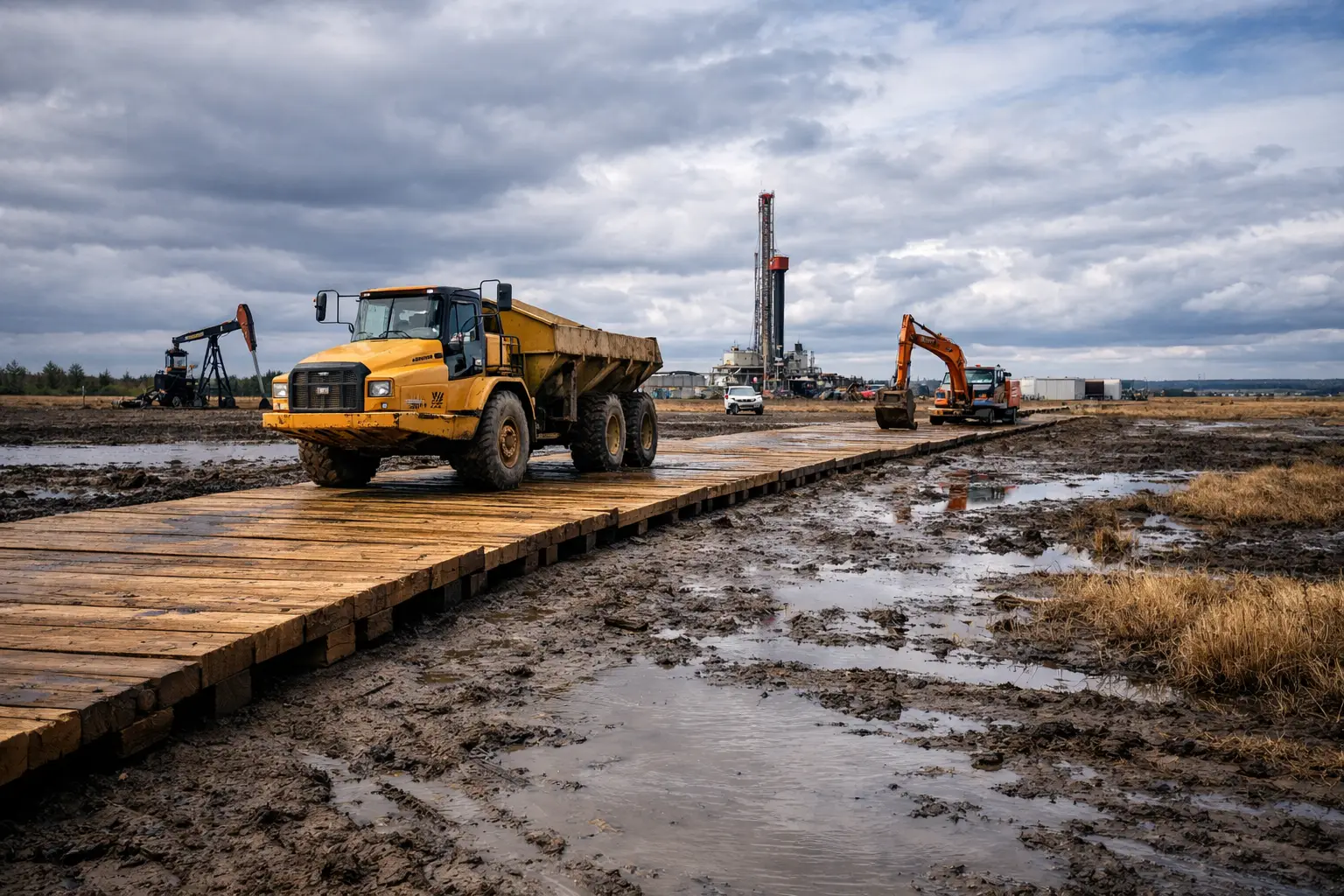
Alberta’s seasonal thaw transforms icy winter ground into a mushy, unforgiving quagmire that becomes a real obstacle to getting to and working safely. Rig mat rentals come to the rescue as an affordable solution to keep sites stable, save the soil, and maintain project timelines when conditions shift quickly.
Address the risks of unstable ground and mud during spring breakup, which threaten oilfield operations and equipment.
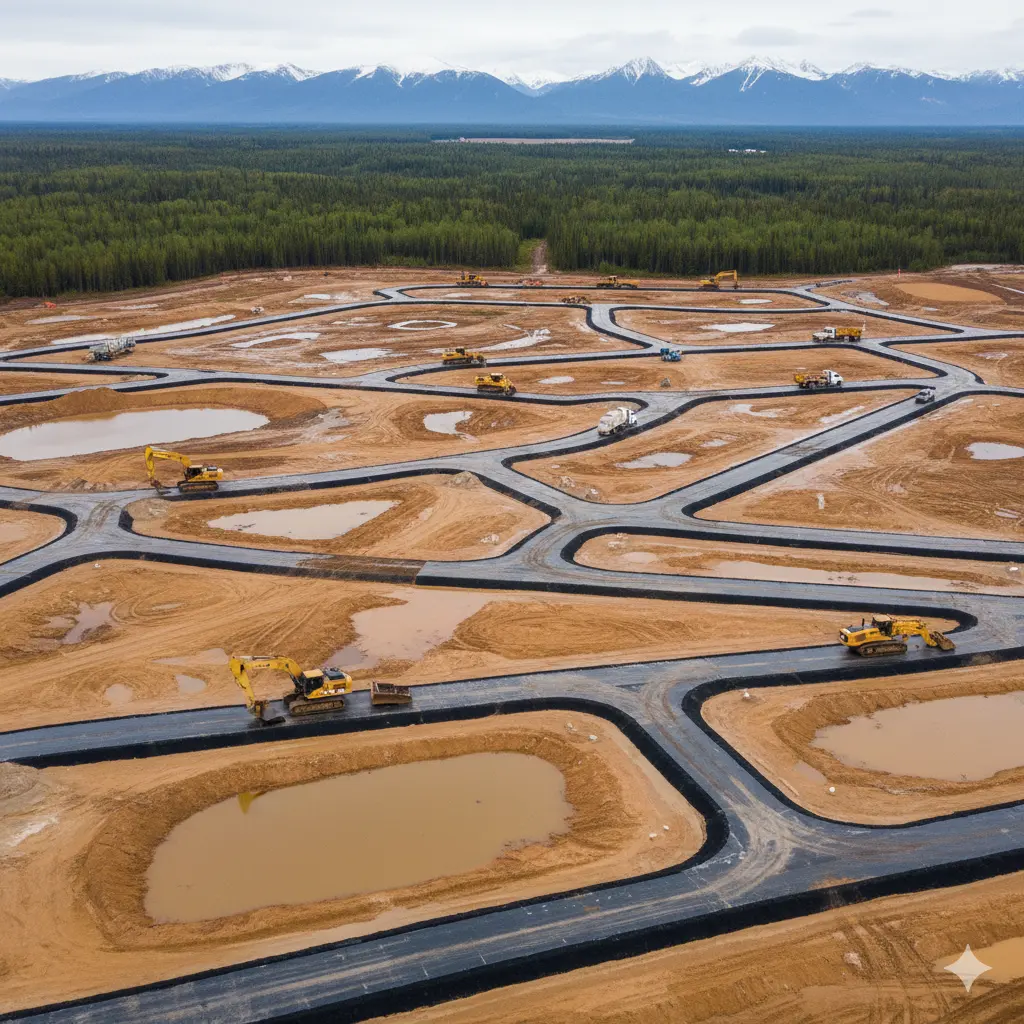
Hard ground turns to slush and deep mud as frost lifts. That transition undermines load bearing strength, so haul roads rut, well pads slump and low spots flood. Trucks sink, tracked units twist and crews slip and trip. In muskeg, the stakes are even greater because water-saturated peat becomes weak when ice lenses thaw. This is not uncommon. Alberta delivers icy winters, fast melt thaws and a muddy melt that send machinery and personnel off track.
Highlight how thawing conditions increase the likelihood of costly delays and site access issues for heavy machinery and vehicles.
Access routes are the first to go. A 40-tonne rig hauler that rolled just fine in February can bog in April. Cleanup eats hours, exhausts cranes and mangles equipment. When a lease road turns to soup, fuel and water trucks cannot get to the pad, so drilling stops and crews sit. Weather swings add strain. Autumn often brings long rain, then sharp cold snaps that turn ruts to ice, and summer muskeg stays saturated. Unpredictable fronts stall work, so schedules need slack and sites need backup plans.
Emphasize the need for reliable ground protection solutions to maintain safe and efficient work environments during seasonal transitions.
Access mats provide a solid, level platform that distributes loads, prevents tires and tracks from sinking into mud, and restricts rut depth. They prevent equipment from bogging, minimize slip hazards, and enable consistent logistics. In the spring, mats assist in holding frost in the ground by reducing heat gain from the sun and traffic, sometimes adding days or even weeks to the working season. With the right mat mix, timber provides flexibility and composite allows for repeat use. Teams stay in motion while slashing rework and recovery trips.
Illustrate the environmental sensitivity of Alberta’s terrain, requiring minimal disturbance and compliance with regulations.
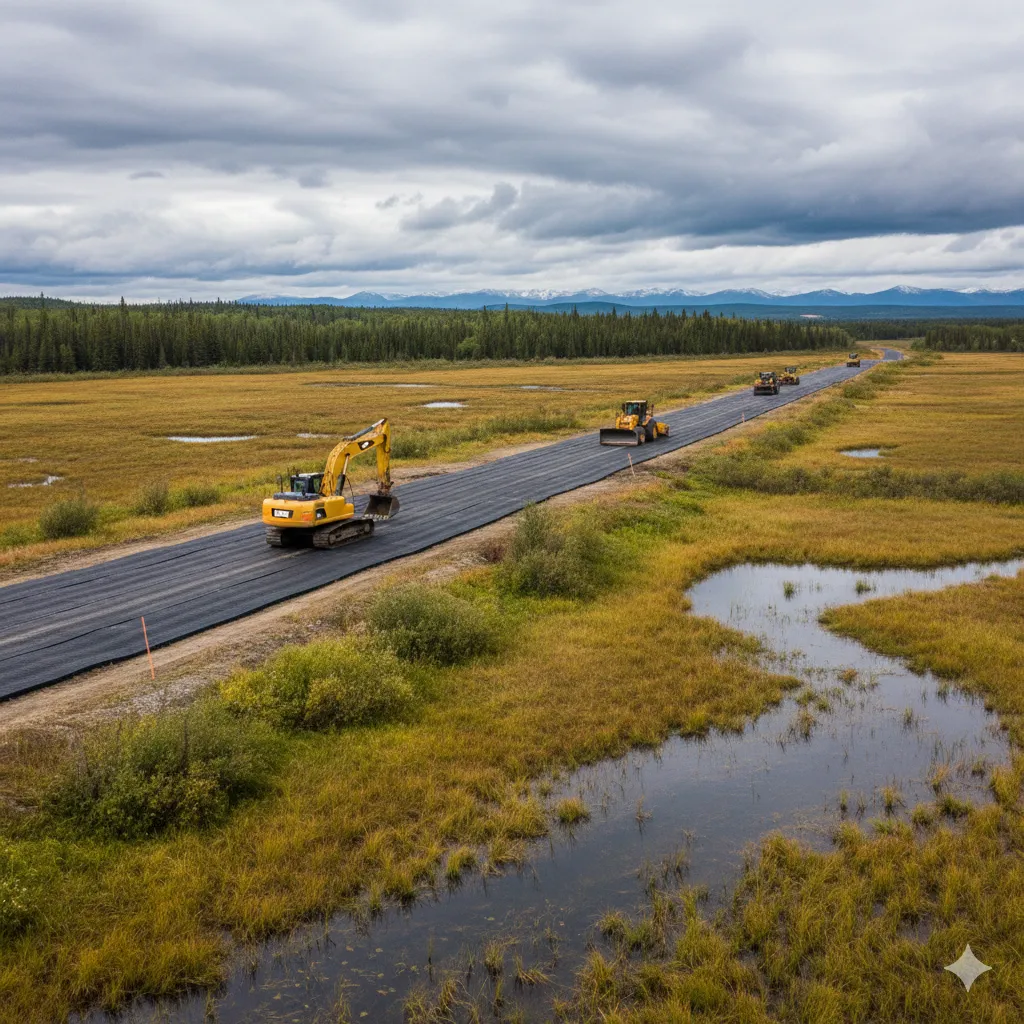
Rivers, streams and muskeg are some of the hardest obstacles in summer and have strict regulations. Mats create temporary crossings that distribute weight and minimize soil churn, vegetation loss and silt runoff. That assists in satisfying permit conditions and reduces reclamation expenses. Alberta’s seasonal extremes—icy winters to waterlogged peat—require planning, specialized equipment and field expertise to keep you compliant and on time.
How Rig Mat Rentals Provide Protection
How Rig Mat Rentals Protect. They distribute weight, reduce rutting, and keep crews and equipment rolling. They accelerate setup and takedown, which helps accommodate evolving scopes and tight work windows.
1. Ground Stability
Rig mats create a solid pad across muskeg, wetlands and difficult grades, so drilling, lifting and access can happen without the need for deep subgrade preparation. With steel-reinforced frames and tough timber or composite surfaces, rig mats spread out the loads, conserve the layer underneath and prevent wheels or tracks from punching through.
Distributing pressure, mats minimize disruption and rutting over wider extents. This assists in swampy corridors, forest tracks, or embankments where a truck in the mud can hold up an entire shift. Crews, light vehicles, and cranes travel with reduced danger anywhere from remote lines or thaw.
A lot of mats are built for tough jobs. Some can withstand 54,400 kg (120,000 lbs) with fluid line inlets. That ability keeps rigs and support units steady, minimizing site repair down the line and keeping schedules on track.
2. Equipment Protection
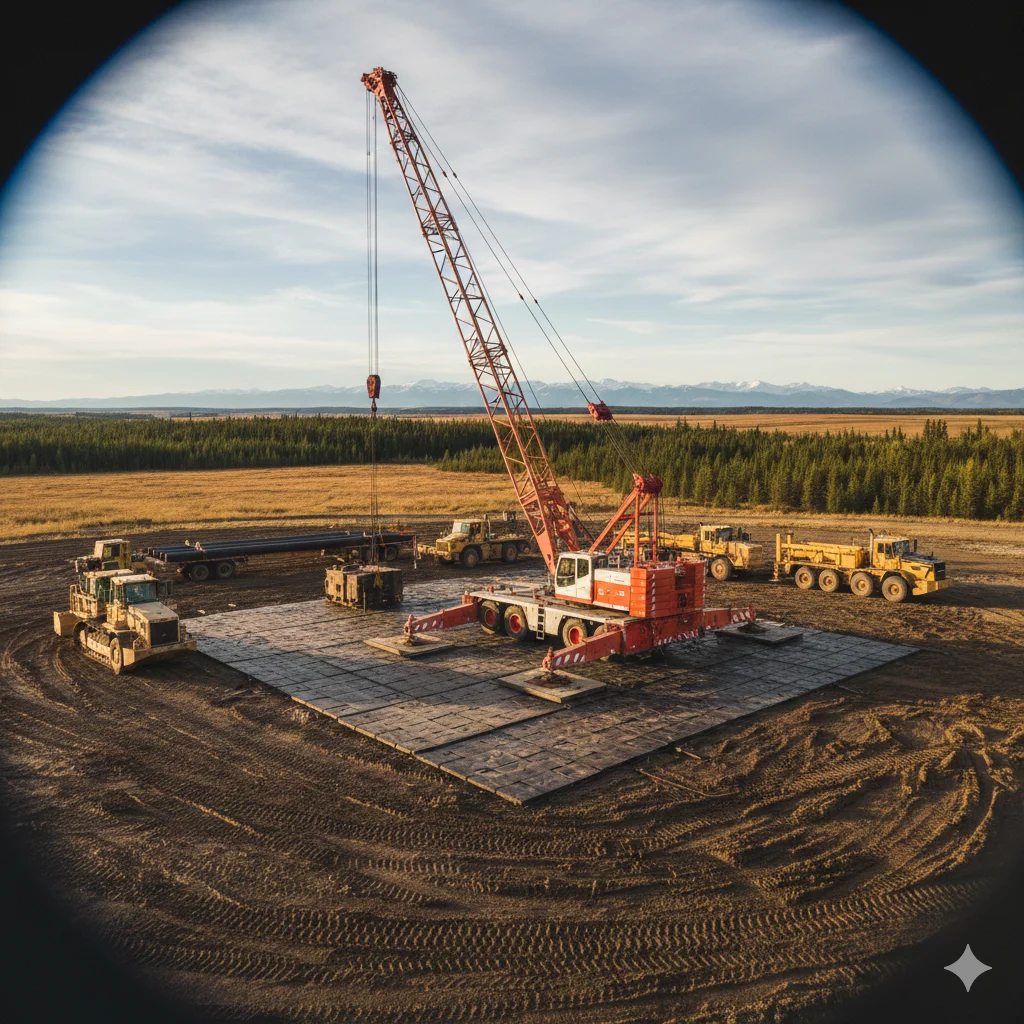
Soft or shifting ground can twist frames, stress booms and foul undercarriages. Mats provide a stable, dry foundation that protects rigs, cranes and haulers from mud, water and debris in wet seasons, increasing service life and reducing unexpected repairs. You gain safer staging: generators, pipe racks, and fuel tanks sit on flat, drained surfaces that cut tip or sink risk.
3. Personnel Safety
Uniform, non-slip walk and work surfaces reduce slip, trip, and fall hazards. Firm footing decreases accident statistics associated with mud, ruts, and concealed holes. Dependable matting not only shields safety regulations and maintains access, but boosts morale and enhances efficiency when crews realize paths and pads won’t give way.
4. Environmental Compliance
5. Operational Continuity
Selecting the Right Matting Solution
Rigid mat rentals depend on aligning mats with site hazards, payloads and duration on location. The aim is firm access, reduced ground impact and secure lifts, all within budget. Choosing the appropriate matting solution is key to the triumph of large construction and energy projects.
Mat Types
| Mat type | Material | Typical use cases | Indicative load capacity |
|---|---|---|---|
| CLT rig mats | Cross-laminated timber | Access roads, pads on soft soils | Medium–heavy, uniform loads |
| Bolted timber mats | Solid timbers with bolts | Crane pads, pipeline spreads | Heavy point loads and lifts |
| Composite mats | HDPE/thermoplastic | Wetlands, low-impact access, fast installs | Light–medium with even load spread |
| Steel frame/steel deck | Steel beams/plates | Extreme axle loads, long-term pads | Very heavy, cyclic loads |
| Crane mats | Large timbers/heavy-duty build | Crane setup, lift paths | Rated to crane gross + lift loads |
CLT vs bolted timber: CLT offers high bending strength from cross lamination, lighter weight per square meter, and fewer fastener failures over time. Bolted mats tolerate sharp point loads and abrasive handling well and resist rolling shear under outriggers.
Composite and steel solutions address edge cases. Composites match delicate surfaces and rapid pace because they clean quickly and minimize soil transfer. Steel frames are the choice for extreme axle loads, high-cycle crane work, or heat-impacted zones.
Site Assessment
- Map construction high-traffic lanes, laydown, rig and crane pads, pipe racks and staging. Think about entryways and turn radii for total coverage and economical use.
Consider slope, soil type, water table, and drainage. As you select your matting solution, keep in mind the surface your equipment will be working on.
Choose sizes that fit gear: typical crane mats are about 1.2 m wide, 300–400 mm thick, and 4.9–12.2 m long. They are heavier in areas where pads bridge gaps or soft soil. Set up in tiers where necessary.
Use findings to write a plan: haul routes, pad build-ups, edge restraints, cleaning, and inspections. Crane mat rentals can be inexpensive for short-term work.
Load Requirements
- 250–400 t crawler crane: bolted timber or steel frame crane mats
- 80–150 t truck crane: bolted or thick CLT with outrigger pads
- 40–80 ton haul trucks: CLT or composite over firm subgrade, steel for poor subgrade.
- Drilling rigs and camps: CLT pads for uniform support, bolted at point loads.
Factor static and dynamic loads: crane swings, braking trucks, and wind on lifts. Crane mats need to be sized to accommodate the crane’s total weight in addition to lift loads. For short or long duty cycles, pick the right matting and talk to suppliers that know how to pair mats to ground and gear. Crane mats build solid foundations and temporary roads while reducing ecological footprint by protecting plants and streams.
The Strategic Value of Renting
There’s a strategic value to renting rig mats. It enterprises access to wide inventories and skilled crews for quick pinning and secure dismantling.
- Do: Match mat type (timber, composite, steel) to ground load.
- Do: Lock in weekly or monthly terms to cut rates.
- Do: Confirm delivery windows and off-hire rules in writing.
- Do: inspect on arrival; note defects with photos.
- Don’t: rely on day rates for months-long jobs.
- Don’t: skip permits or ground surveys before install.
- Don’t: ignore rush fees of 15–30% on late orders.
- Don’t: underestimate removal time or weather delays.
Cost-Effectiveness
Renting decreases the entry barrier. You sidestep big capital expenditures, so cash remains open for work-related things like cranes, crews, or traffic control. This fits one-off or seasonal work and weather-locked scopes.
You bypass storage yards, lifts and repair budgets associated with owned mats. No dry rot check, pressure washing, or hardware swaps. Life-cycle costs are taken care of by the provider.
You pay only for what you need and how long you need it. For unknown timelines, you can off-hire early, which is a boon when rain halts access or a permit moves. Beware daily rates; they compound quickly if a two-week scope slips into two months.
Wallpaper your desktop with their quotes. Inquire about weekly or monthly rates and request reductions for longer periods. Leasing can be better than renting on lengthy jobs with flat, lower per-mat rates and stable budgets. Clarify cartage, laydown time, idle day rules and damage schedule.
Logistical Simplicity
Turnkey rentals include delivery, installation, and pickup. That minimizes lift planning, site traffic, and crane time.
Vendors manage sizing and counts, staging the appropriate combination of 3 to 6 m panels and crossovers on demand.
A single agreement for multiple sites simplifies approvals and invoicing. Share a call-off schedule to sync drops and demob.
Today a spruced-up fleet and skilled crews travel from location to location quickly. That facilitates corridor work, pipeline tie-ins or wind farm pads over large expanses.
Maintenance and Inspection
They sanitize and inspect between users, replace torn pads and tighten bolts.
Mats come ready to go, so crews can get to work day one.
Properly maintained stock reduces slip hazards, bogging, and stuck haul trucks, which helps maintain uptime.
All inspections, cleanings, and repairs are included in the rent. Specify response times and replacement conditions to minimize downtime.
Beyond the Mat: Comprehensive Site Access
Rig mat rentals go beyond simple ground cover to a complete access plan that connects individuals, equipment, and schedules. Outside the mat in backcountry, remote, rugged, and sensitive areas, weather, mud, and protected terrain impede work and increase danger. A well-matched matting system keeps sites open, safe, and compliant while reducing rework and cost.
Integrate rig mats with other access solutions like temporary roadways, bridges, and portable platforms.
Rig mats, referred to as access mats, create sturdy pathways for trucks and cranes. Temporary roadways provide additional length and pace over soft terrain. Utilize portable bridges at creek crossings to maintain flow and preserve banks. Set modular platforms at work pads, laydown yards, and staging areas for lifts and drilling. Thaw or rain, geotextile under mats to spread load and stop rutting. For wetlands, combine lightweight road panels with wide rig mats to lower ground pressure. This blend allows yards to run on a pre-determined course and reduces clean-up afterwards.
Address complex site challenges by combining matting with infrastructure support for pipelines, tanks, and camps.
About: Beyond the Mat: Deep Works Site Access This is why, for pipeline spreads, we put heavy duty mats at crossings and stringing areas. In fact, some of our engineered mats hold more than 54,000 kilograms to withstand sidebooms and bends. Solid top with solid core mats are approximately 20 percent stronger than standard mats and minimize shear beneath tracked equipment. Containment-grade platforms under tanks and fueling areas shield soil and waterways. Camps require dry, level foundations for foot traffic, power skids, and waste lines. Matted walkways keep mud off and reduce falls.
Support diverse industries—including mining, forestry, and construction—with tailored access matting solutions.
Minesite beyond the mat – full site access. Our forestry teams guard roots and streams during harvest and delivery. Beyond the Mat: Wide open shot about with full site access. In Canada’s construction and energy sectors, dependable ground support is key to achieving winter and thaw windows and minimizing damage to vegetation and oil underneath. Selecting the appropriate mat type, thickness, and layout is essential for you to prevent project delays and unexpected costs.
Partner with a trusted provider offering a full suite of services, from planning to execution, for seamless site access.
Beyond the mat to full site access. Find a partner who studies routes, load ratings, environmental regulations, transports, installs and pull-out. They should clarify that “rig mats” (steel-framed, heavier) are different than “access mats” (lighter, faster to deploy) and pair each to application. Think stamped bridge designs, lift plans for cranes, up-to-the-minute weather checks and on-call swaps when the ground moves. One source maintains visibility, enhances security and accelerates completion.
Measuring Your Return on Investment
ROI on rig mat rentals results from less downtime, safer locations and cleaner closeouts. The goal is to determine whether mats reduced overall project cost per day and per metre moved, not just day rates. Follow baseline metrics for two months pre-mats, then the same window post-rollout, and normalize by site size, crew hours and weather.
Display a summary table comparing key performance indicators before and after implementing rig mat rentals.
| KPI (normalized) | before mats | after mats | delta | About: Calculating Your ROI | Average site access delays (hours/week) | 14 | 6 | negative 8 | | Equipment bog-down incidents (per 1,000 m) | 3.2 | 0.8 | negative 2.4 |
| Recordable injuries associated with reach (per 200k hours) | 1.1 | 0.4 | -0.7 |
| Allow non-compliance incidents (per month) | 0.6 | 0.1 | minus 0.5 |
| Regrading/restoration cost (EUR/m²) | 5.0 | 2.1 | minus 2.9 |
| Fuel burn for access (L/day) | 780 | 610 | 170 | | Average cycle time per haul (mins) | 42 | 34 | 8 |
Quantify improvements in operational efficiency, safety, and compliance resulting from mat rentals.
Time: If access delays drop 8 hours per week and your blended crew and equipment rate is EUR 3,000 per hour, weekly savings near EUR 24,000. Over 16 weeks, that equals €384,000.
Equipment: Cutting bog-downs from 3.2 to 0.8 per 1,000 m reduces recoveries. At €4,500 per recovery and 30 km of moves, the avoided cost is approximately €324,000.
Fuel: 170 liters per day lower burn at EUR 1.60 per liter over 120 days yields approximately EUR 32,640.
Safety: A 0.7 TRIR reduction can lower insurance modifiers and indirect costs. If each recordable averages EUR 18,000 direct and indirect, and you avoid two events, that equals approximately EUR 36,000.
Compliance and land rehab: Restoring 12,000 m² at EUR 2.9/m² saved approximately EUR 34,800. Less non-compliance incidents prevent fines and work stoppage risk as well.
Calculate the value of flexible rental options versus the long-term costs of mat ownership.
Begin with time. For short-term needs—generally 12 to 18 months or less—renting is usually optimal. Since rates tend to be per day, you pay for what is actually used and keep cash free. Rentals relocate storage, scrubbing, and much of the logistics to the provider. Massive volumes travel on specialized trucks that rental fleets already operate.
Buying can pay off in the long run. Add a decent storage system up front, along with carrying equipment. Poor storage reduces lifespan, increases replacement expenditure, and occupies valuable space. Include transport to and from sites, lay up during the off season, and admin. Mat lost or damaged? Replacement fees either way – with rentals, check damage terms and caps. Run a total cost model: rental day rate multiplied by active days plus mobilization versus purchase price divided by expected life plus storage plus transport plus maintenance plus loss rate. Revisit when project mix or site soils change.
Conclusion
Rig mat rentals provide quick site access during thaw. Crews move in as scheduled. Equipment stays secure. Roads withstand. Expenses remain under control. That obvious, straightforward value manifests itself in safer work, fewer stuck loads, and less site repair.
To select a mat, align load, earth and distance. For a wet lease road, use timber or CLT with grip. Crane pad? For muskeg, use wide, thick panels to distribute weight. Monitor utilization and restoration with transparent logs, GPS drops, and image verifications. Share easy-to-understand scorecards with the team every week.
Prepared to map out your spring break up route? Just submit your lane map and axle loads. Receive a floor plan, a price, and a commencement date.
Frequently Asked Questions
What are rig mats and why are they essential during Alberta’s thaw?
Rig mats are known as heavy-duty portable platforms. They distribute loads, safeguard soft terrain and maintain access to sites during freeze-thaw. In Alberta’s melt, they minimize mud, equipment getting stuck and downtime. They assist in achieving environmental and access compliances.
How do rig mat rentals protect equipment and the environment?
Rentals provide stable, non-slip surfaces. They minimize soil disturbance, prevent topsoil and subsoil from mixing, and control sediment. This safeguards vulnerable spaces and minimizes cleanup. Equipment moves safely with less chance of damage, leaks, or delays.
How do I choose the right rig mat for my site?
Match mat type to loads, soil, climate and project duration. Think timber, CLT, or composite. Inspect connection systems, traction and thickness. Request engineering assistance, load charts and case studies to confirm performance.
When is renting rig mats better than buying?
Rent when projects are short-term, seasonal, or fluctuating. Renting avoids capital expense, storage, transport, and maintenance. You get to newer inventory quickly. Buy if usage is high all year and you can handle the logistics.
What services should I expect beyond the mats?
Look for turnkey site access: planning, engineering, delivery, installation, cleaning, and removal. Leading suppliers provide access road, temporary bridges, erosion control, and around-the-clock assistance. This mitigates risk and maintains schedules.
How do I calculate the ROI of rig mat rentals?
See if rental costs are minuscule in comparison to avoided downtime, equipment recovery, site repairs, and fines. Add quicker mobilization, less weather delays, and reduced reclamation. Measure productivity, incident, and schedule savings to quantify the gains.
Are rig mat rentals compliant with environmental and safety standards?
Trusted providers adhere to local laws and industry standards. Anticipate logged maintenance, non-leaching materials, cleaning regimens, and certified crews. Request safety statistics, insurance, and environmental compliance to ensure credibility.
Not what you were looking for? Browse Benoit’s top resources for equipment rentals.
For added knowledge, consider reading the resources below.
Certified Equipment and Workplace Safety Standards