
- Key Takeaways
- How Light Towers Enhance Safety
- Choosing Your Light Tower
- The Rental Advantage
- Beyond Illumination
- Our Rental Commitment
- Navigating Alberta Regulations
- Stay compliant with provincial safety and environmental standards by choosing certified rental light towers.
- Receive guidance on proper placement, brightness levels, and permitted power sources for your specific location.
- Access documentation and support for regulatory inspections or audits related to temporary lighting equipment.
- Ensure your project meets all legal requirements for work site safety, emissions, and equipment operation in Alberta.
- Conclusion
- Frequently Asked Questions
- How do light towers improve site safety?
- What factors should I consider when choosing a light tower?
- Why rent light towers instead of buying?
- What features matter beyond illumination?
- How do you ensure reliable rental equipment?
- Do I need permits to use light towers in Alberta?
- Can light towers handle extreme weather?
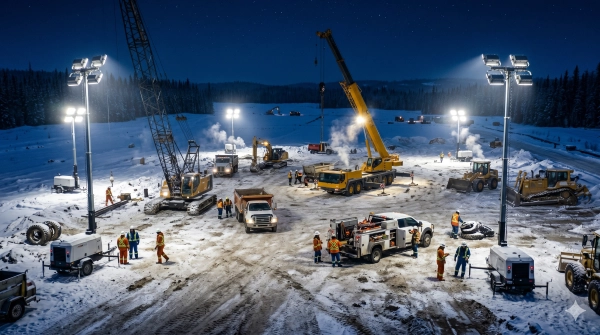
Key Takeaways
- High-brightness LED light towers enhance safety and productivity by eradicating dark spots, powering compliance, and facilitating 24/7 operations during those brief winter daylight hours. Use deployable chainable units and routine checks to keep coverage consistent.
- Select the optimal power source for your site requirements, balancing runtime, emissions, and costs. Diesel is suitable for remote endurance, solar is ideal for silent and clean operation, and electric is appropriate for low-noise, grid-connected projects.
- Light tower rentals provide cost and operational flexibility, with a serviced fleet, expedited delivery and no maintenance obligations. You can scale units up or down as project scope or seasons change to keep costs in check.
- Illuminate tasks while caring for workers with focused, glare-free LED lighting that minimizes fatigue and mistakes. Tilt mast height and angles for close-in work such as welding, surveying and inspections.
- Fortify safety and emergency preparedness by lighting perimeters, pairing with cameras and smart controls, and maintaining transportable units for quick dispatch. Keep your light burning with remote monitoring and alerts.
- Remain compliant and audit-ready with experts on placement, brightness, and approved power sources for your area. Maintain documentation and confirm equipment certifications prior to site deployment.
Light tower rentals are temporary or project-based leases of portable lighting units that utilize diesel, solar, or hybrid power to illuminate work sites, events, and emergency zones. Typically, units have a mast height of 6 to 9 meters and deliver between 100,000 and 600,000 lumens with coverage appropriate for a few thousand square meters of area. Common amenities include LED fixtures, 360-degree mast rotation, quiet mode, and towable trailers for simple mobility. Rentals are available on daily to monthly plans with add-ons such as fuel service, delivery, and on-site setup. Safety regulations revolve around glare management, spacing, and runtime scheduling. The sections below list types, costs, sizing steps, and practical advice for choosing the best unit.
How Light Towers Enhance Safety
Light towers deliver dependable light that minimizes hazards in dark spaces and enables crews to operate securely through extended shifts and brutal seasons. Key benefits of high-brightness LED towers:
- Consistent illumination eliminates glare and shadows for unobstructed visibility.
- Low power consumption with a long lifespan minimizes downtime.
- Easy start, immediate restrike and silent operation for night work.
- Portable designs that move as site layouts change
- Complies with Alberta safety regulations by illuminating access roads and work areas.
- Maintains site efficiency during short winter days and harsh weather conditions.
- Assists in avoiding accidents and expensive delays that affect both personnel and equipment.
1. Accident Prevention
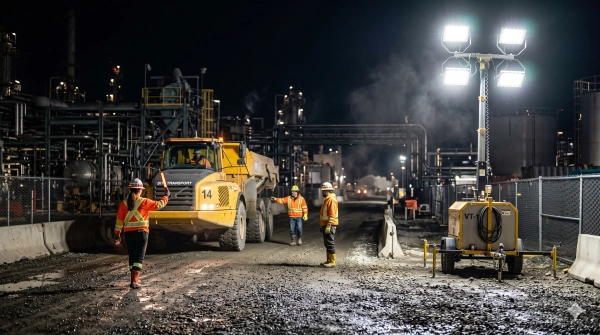
Position towers at access roads, laydown yards, cranes and pit edges to eliminate blindspots. Aim heads to overlap beams and minimize harsh contrast. Light prevents slips, trips and strikes by in night work or dust, fog, or snow.
Illuminate hot zones—excavations, energized areas, lifting paths and haul routes—with brighter, whiter light. Illuminate moving trucks and active machinery so spotters and operators notice hand signals and hazards in advance.
Employ chainable, linkable towers on long linear sites to maintain even light along pipelines, wind farms, or highway lanes. This minimizes missteps and side swipes at shift change.
Have periodic checks by trained techs to make sure the mast is stable, the beam angle is correct, the lux levels are appropriate, and the fuel or battery status is monitored. It doesn’t matter if you can do 100 hours a week on day one if you can’t keep it up.
2. Worker Morale
Illuminated paths and work fronts increase confidence for crews beginning before dawn or departing late at night. They feel safer walking to parking areas and remote camps.
LED white light reduces eye fatigue, assists in color identification, and maintains consistent concentration. This can reduce rework and near-miss rates. Dependable illumination communicates concern for health, which can help engender loyalty and efficiency.
3. Security Deterrence
Powerful light at gates, fences, and staging areas discourages loitering, theft, vandalism, and other crime. Bright light alters behavior by eliminating shadows and uncertainty.
Include clever timers and sensors to pretend there’s activity after hours. Light towers with cameras provide good light for clear footage and increased surveillance. Mobile units can move quickly for incidents, outages, or alerts and allow security to get to incidents quicker with less disorder.
4. Task Precision
Targeted, glare-free lighting at benches and bays aids in precise cuts, lifts, and tool utilization. Mistakes in measuring, fitting, and checking decrease when light is even and shadows remain diffused.
Hydraulic masts adjust height and tilt, allowing crews to fine-tune beams for trenching, steel work, or form inspections. Concentrated output helps support welding arcs, survey points, and precision repairs without washing out marks or screens.
5. Emergency Response
Its portable towers roll to crashes, outages or storm damage so responders see dangers immediately. This quickens ambulance access in isolated areas and helps security orchestrate duties.
We maintain an on-call rental fleet across Alberta for quick delivery day or night. Generator or battery backup units can keep scenes illuminated if grids go down. Quick-setup teams can move towers as priorities shift and perimeters grow.
Choosing Your Light Tower
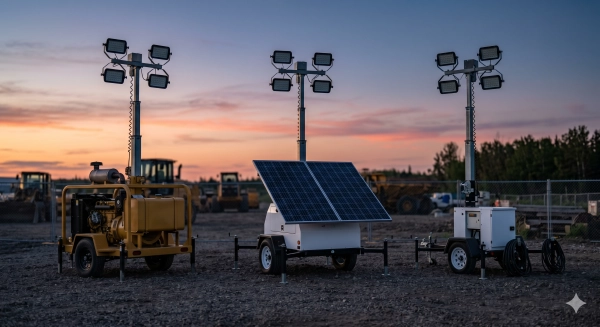
Align the tower with your site objectives, budget, and regulations. Focus on six factors: brightness and coverage, power source, mobility, durability, noise, and service needs. Add cost lens: rental versus ownership and total cost of ownership, not just the day rate.
| Model type | Power source | Mast height (m) | Lumen output | Fuel/battery capacity | Noise (dBA) | Best use cases |
|---|---|---|---|---|---|---|
| Diesel—standard | Diesel engine | 7–9 | 150,000–220,000 lm | 150–250 L | 65–75 | Remote sites, long shifts, extreme cold |
| Diesel—low-noise | Diesel engine | 8–9 | 160,000–200,000 lm | 150–200 L | 55–60 | Urban night work, hospitals, events |
| Solar—battery | PV + Li-ion | 7–8 | 80,000–120,000 lm | 15–30 kWh | 45–55 | Parks, protected areas, low-emission zones |
| Electric—corded | Grid or generator | 6–8 | 100,000–180,000 lm | N/A | 45–55 | Indoor, downtown sites, tunnels |
| Hybrid | Diesel + solar/battery | 8–9 | 140,000–200,000 lm | 50–150 L + 5–15 kWh | 55–65 | Mixed-duty, idle-reduction mandates |
Compare power sources by fuel use, emissions and cost. Diesel has the longest runtime per refill and the most steady output, but has more emissions and fuel spend. Solar eliminates fuel costs and tailpipe emissions, with battery storage bridging nights. Output is a function of sun and battery size. Electric connects to site power or a generator, eliminating fuel handling and reducing the operating cost per hour when grid rates are below diesel. Hybrid cuts idling and fuel burn, which is handy where partial solar is possible.
Consult technicians to size brightness and beam spread to task zones: road repair lanes, large laydowns, or small pits. Map your pole count and spacing to safe lux levels. Alberta’s wild weather confirms wind ratings, cold-start packages, sealed electrics, and IP65 fixtures. Select mast height to minimize glare and shadows. Use 8 to 9 meters for wide pads and 6 to 7 meters for tight streets. Mobility matters: look for compact trailers, forklift pockets, and highway-legal towing since towers may sit for weeks and then move.
Diesel
Select diesel for off-grid locations and extended winter nights. Kubota and Isuzu engines are proven, with easy-to-source and service parts in the harshest of conditions.
Gargantuan tanks extend refuel intervals for multi-shift operations. Some towers supplement 230 V or 400 V outlets to operate small tools or charge batteries, eliminating additional gensets.
Solar
Solar suits eco-sensitive areas and noise restrictions. No fuel delivery reduces risk and aids green regulations.
Battery banks deliver past brief winter days. Setup is fast and easy with minimal site prep, perfect for event or pop-up work.
Electric
Electric where you have site power to drop fuel costs and refills. Connect to camp grids or house generators for a seamless tie-in.
Noise stays down for city jobs or near houses. Small models nestle inside or in narrow passageways. Look for 600-hour service intervals, 55 dBA options and service-friendly designs such as single pop-up canopies with 360-degree access. Consider renting for less than 6 months and buying for longer. Match engine or solar needs to site rules and total cost of ownership across fuel, upkeep and noise.
The Rental Advantage
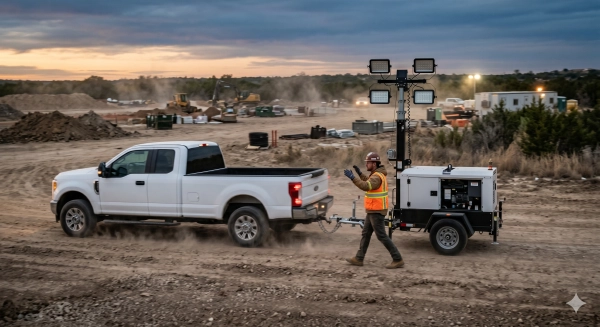
Light tower rentals provide access, speed, and control with no long-term commitment. They are great for short builds, one-off events, or emergency work where requirements change quickly.
- State-of-the-art diesel, hybrid, and LED towers scaled for the site, event, or response zone.
- With units that have quiet modes at night or in noise-sensitive locations.
- Trailer-mounted, skid, and vertical-mast options for tight or soft ground.
- Models with 6 to 9 m masts, 4 to 8 LED heads and 50 to 200 m radius coverage
- We handle delivery, setup, refueling plans, and de-rig for you end to end.
Financial Sense
Renting makes a fixed cost variable. You pay when you require illumination, not when equipment idles. This leaves capital open for main efforts and avoids locking funds in equipment used a few weeks per year.
Prices scale by term, so a weekend festy, a two-month road job, or wet-season outage gets fair pricing. Term specials can reduce per-day price, which assists with slim margins and competitive pricing pressure.
You reserve just the units and days you require. Transparent quotes and clean payment terms support cost certainty, which helps alleviate last-minute budget stress for event teams on tight schedules. ROI improves for seasonal or one-time projects, and conscientious selections such as LED units reduce fuel and emissions, assisting sustainability efforts.
Operational Agility
They come up after storms or a night pour or delayed closing. With rentals, dispatch and installation can take place the same day in most locations. That minimizes downtime and keeps crews on the move.
If scope increases, switch to higher-lumen LED heads, add towers to cover a larger laydown or transition to hybrid units for quiet areas. Better maintained fleets are less likely to fail and keep production moving across Alberta and other networked regions.
Weather changes, permits fall through and crowds expand. Rentals allow you to flex without hard contracts. This fits for weddings, street fairs, medium-sized concerts and festivals requiring unique coverage from dusk until late.
Zero Maintenance
Service is built in, from scheduled checks to parts and field support, so there is no workshop time, spares stock, or technician callouts on your side. All units come tested, fueled to schedule, and ready to run, reducing breakdown potential during prime hours. Technicians perform service inspections, lamp head swaps, alternators, and diagnostics, and you stay on target. The global rental market keeps growing for this reason: access the capacity you need without ownership drag.
Beyond Illumination
Light tower rentals do more than light up a site. They power safer shifts, stricter schedules, and leaner expenses throughout industries operating after dark or in isolated locations.
Smart Controls
Programmable timers, photocells and motion sensors turn lights on only when necessary. This reduces unnecessary idle run time and fuel consumption while maintaining consistent light levels for activities such as concrete pours, rail work or stadium dismantling.
Remote dashboards and mobile apps enable crews to monitor fuel, battery condition, lamp hours, and mast position via a wireless connection. Dim zones, impose curfews, or stagger starts to manage load in a couple of taps.
Less hand patrol leads to fewer site rounds at night. Automated workflows, including on, off, and dim transitions, occur on time, reducing overhead and enabling teams to race ahead while keeping eyes on the road.
Real-time alerts highlight low oil, obstructed airflow or charging malfunctions. Early warning avoids blackouts and maintains broad, uniform illumination on essential zones such as lanes, laydown yards or perimeter walkways.
Greener Power
LED towers and hybrid units reduce fuel consumption and quiet noise, which is useful on city lots or sensitive habitats. LEDs provide uniform beams with reduced glare, and mast heights up to 9 m cover large areas with fewer units.
Solar-assist or battery-only towers operate off-grid and have no tailpipe emissions. This fits mining, forestry, or beach sites where air quality regulations are severe and motors are constrained.
Less noisy, less dirty systems underpin permits and stakeholder objectives. Cooler night shifts provide crews with added comfort, which increases their pace and quality, particularly on long-haul paving or pipeline inspections.
For crops, night lighting promotes planting when the soil is cooler and moisture is more abundant, aiding seedling start. Burning the midnight or pre-dawn oil can maintain harvest momentum.
Custom Add-ons
Security cameras and motion sensors prevent intrusion and capture location logs. Two hundred thirty V outlets energize small tools, chargers, or sensors without a stand-alone board.
Exchange lenses or filters to adjust color and diffusion. Warm tones cut operator glare and narrow beams fit tall cranes. Broad inundations are suitable for mounds of earth.
Add unit branding or quick tags for rapid asset identification on big projects. Assemble stacks of light towers with generators or temporary fencing to accelerate deployment for overnight road work that needs to meet public deadlines.
Night work is brutal. Light towers make it safer, faster, and more valuable. Most teams see decreased downtime that pays for rental within a phase. Portable units leapfrog from job to job, staying in sight where the work migrates.
Our Rental Commitment
Service, speed, and suitability power our light tower leases. Things move quickly on projects, so we maintain straightforward terms, reasonable USD pricing, and possibilities for brief or extended rental. Units span construction, infrastructure, and events where safe light is essential, day or night.
24/7 Support
Our Rental Commitment. 24/7 assistance includes installation, start-up verification, troubleshooting, and replacement emergencies. If a mast motor fails at 02:00, a replacement leaves at once with on-site guidance for safe handover.
Technicians understand Alberta weather, winterization requirements to minus 30 degrees Celsius, and local regulations regarding noise, spill kits, and site lighting levels. They recommend mast height, beam spread, and location to minimize glare on roadways or adjacent residences.
A direct line routes emergency modifications, such as bumping a weekend shift or throwing in two towers prior to a night pour. You receive consistent updates on delivery ETA, fuel service windows, and maintenance notes so crews schedule without guesswork.
Rapid Deployment
Close deadlines require rapid actions. We ship towers the same day to remote sites, including gravel access or frozen roads, and stage units near highway exits for faster access.
Logistics teams schedule drop points and cable runs to reduce site traffic and noise. For night shifts or emergency work, we time off-peak deliveries and lift-in placements to keep crews moving.
Stock sits in Alberta to support immediate demand. When storms cause demand spikes, we have buffer units to cover unscheduled work.
Maintained Fleet
| Type | Power source | Typical run time | Output range | Sample makers | Service cadence |
|---|---|---|---|---|---|
| LED diesel | Diesel | Up to 360 h/tank | To 542,000 lm | Doosan, Generac | Pre/post job + 250 h |
| LED solar-hybrid | Solar + battery | To 40 h stored | Mid–high lm | Atlas Copco | Pre/post job + monthly |
| Electric corded | Grid | Continuous | High lm | Allmand | Pre/post job |
| Battery LED | Battery | 8–20 h | Mid lm | Wacker Neuson | Pre/post job + monthly |
Each unit is cleaned, inspected and load tested prior to dispatch. We store extra lamps, controllers, and alternators in the shop along with backup towers for immediate swaps. Models illuminate up to 4,900 square meters, with adjustable masts from 7 to 9 meters to direct light where teams require it.
We fit the equipment to the job. A little city dig probably uses a silent electric model. A country bridge pour might require diesels with 360 hour endurance. A green event often chooses solar-hybrid to reduce fuel. Customers can test drive units prior to buying, compare diesel to solar and select what suits duty cycle and price. Quotes are competitive, with flexible daily, weekly and long-term rates, along with specials for multi-month work. Battery, corded, diesel, and solar options allow teams to mix and match power sources on location for consistent, secure lighting.
Navigating Alberta Regulations
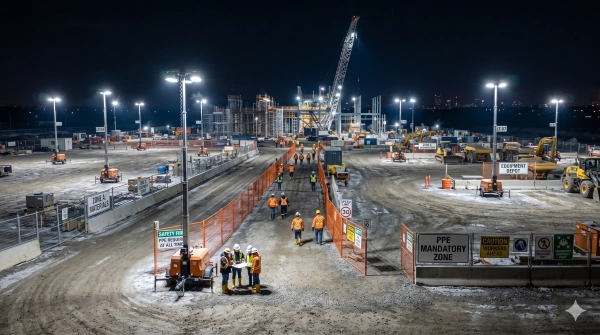
Stay compliant with provincial safety and environmental standards by choosing certified rental light towers.
Look for units that meet the Alberta Occupational Health and Safety (OHS) Act and Regulation requirements for safe operation, guarding, and stability. Ask for documentation on CSA or equivalent electrical certification, spill containment features for diesel models, and noise ratings. In sectors like construction, oil and gas, and forestry, regulators expect adequate illumination to prevent slips, trips, traffic strikes, and equipment errors. Choose models with adjustable masts ranging from 8 to 12 meters, glare shields, and dimmable LED heads to match task needs without over lighting. For sites near waterways or sensitive land, confirm secondary containment that equals 110% of tank volume and fuel handling procedures. Employers must run regular risk checks for hazards, including poor lighting. Certified gear provides a strong baseline for those assessments.
Receive guidance on proper placement, brightness levels, and permitted power sources for your specific location.
Request that the rental supply company position towers to eliminate glare and shadow at work faces, stairs, and traffic routes. As simple rules of thumb, place towers up-sun from the task, angle heads 30 to 45 degrees down, and overlap light footprints by one-third. Aim for 200 to 300 lux for high-risk activities. Twenty to fifty lux often works for laydown yards and parking. LEDs provide consistent output in Alberta’s cold weather. Check power rules on your site, as some areas limit diesel use at night or set idling or emissions caps. Hybrid or battery-LED towers cut fuel consumption and exhaust in areas with harsh air permits.
Access documentation and support for regulatory inspections or audits related to temporary lighting equipment.
Keep on file: equipment manuals, inspection logs, maintenance records, proof of electrical conformity, spill kits inventory, and site lighting plans with lux targets. During an OHS inspection, show your risk assessment that flagged lighting needs and worker training records on tower startup, tilt checks, and emergency shutoff. Workers may refuse unsafe work if light is not enough. A prompt lighting review and corrective plan helps resolve that.
Ensure your project meets all legal requirements for work site safety, emissions, and equipment operation in Alberta.
Connect lighting inspections to daily toolbox talks, weekly hazard analysis, and incident reports. When rules aren’t clear, use Alberta government guides and helplines or consult a safety professional. Tweak plans as tasks shift, seasons evolve, or audits expose holes.
Conclusion
In summary, light tower rentals create sites that are safer, faster, and more cost intelligent. Sharp light slices through falls and close calls. Crews notice equipment, ropes, and placards. Jobs keep going in the dark, fog, or long nights.
Choose units appropriate to the location. For a small lot, opt for a compact LED set. For a wide pit, select a diesel unit with 9 to 12 meter masts and 4 to 6 heads. Need peace and quiet in residential areas? Hybrid or solar can do much of the work.
Renting keeps costs lean. There is no large purchase. There is no extended maintenance. Trade in equipment as requirements shift. In Alberta, comply with local regulations, mark risks and maintenance visits.
Looking for a quote or speedy spec match? Share site size, runtime, and fuel restrictions. We will hook you up.
Frequently Asked Questions
How do light towers improve site safety?
Light towers prevent accidents. They light hazards, paths, and workflows. Good lighting fosters security and compliance. Select towers with adjustable masts and 360-degree coverage to ensure consistent light.
What factors should I consider when choosing a light tower?
Match light output (lumens), fuel type, runtime, mast height, and coverage to your site. Consider noise, terrain, and portability. Think about LED versus metal halide and automatic start/stop and telemetry for efficiency.
Why rent light towers instead of buying?
Renting reduces your initial investment and your maintenance risk. You get the right model for every project, quick shipping, and expert support. Our rentals scale with demand and come with service, which minimizes downtime and the overall cost of ownership.
What features matter beyond illumination?
Watch for emission compliance, quiet operation, fuel efficiency and telematics. Extras such as solar-hybrid options, spill-proof bases and towable frames increase worth. Security lighting, emergency flares and motion sensors can increase functionality.
How do you ensure reliable rental equipment?
We supply late-model units, inspected and serviced prior to each rental. You get documented maintenance histories, 24/7 support, and on-site installation if required. Defined pass-off training guarantees safe and efficient operation right from day one.
Do I need permits to use light towers in Alberta?
Depends on location and application. Adhere to Alberta OHS regulations, municipal bylaws, and environmental standards. Control noise, exhaust, and light spill. We assist with compliant setup, spec sheets, and documentation to make approvals smoother.
Can light towers handle extreme weather?
Yes, with correct specifications. Look for units with durable masts, wind ratings, cold start systems, and waterproof enclosures. LED towers perform well in cold temperatures and minimize maintenance. Always fasten and orient units according to manufacturer specifications.
Not what you were looking for? Explore more equipment solutions from Benoit Rentals Ltd to learn about reliable oilfield rentals that support safe and efficient wellsite operations.
Mobile Office Trailers for Oil and Gas Industry
For more information about oilfield operations, environmental protection, and regulatory oversight, visit these trusted references:
Oil and Gas Regulations and Compliance Enforcement of Alberta
Overview of Oilfield Gas Flaring Systems