
- Key Takeaways
- Defining Core Functions
- Flare Stacks vs Test Separators
- Choosing Your Equipment
- Beyond the Basics
- An Operator’s Perspective
- Optimizing Your Well Test
- Conclusion
- Frequently Asked Questions
- What is the main difference between a flare stack and a test separator?
- When should I use a flare stack during well testing?
- Why is a test separator critical for well performance evaluation?
- Can a flare stack replace a test separator?
- How do I choose between a two-phase and three-phase test separator?
- What safety factors matter most when sizing a flare stack?
- How can I optimize my well test using both flare stacks and test separators?
Key Takeaways
- Flare stacks and test separators have distinct core purposes, with flare stacks prioritizing the safe combustion of waste gases and test separators emphasizing precise oil, gas, and water measurement. Knowing this difference allows operators to select equipment that supports their safety priorities or information requirements.
- Flare stacks are essential safety equipment that safeguard personnel, equipment, and facilities during emergencies, process upset, and pressure relief situations. Ongoing inspection, maintenance, and utilization of smokeless and high-efficiency designs reduce environmental impact and enable regulatory compliance.
- Test separators give you detailed production data, including phase volumes, flow rates, and fluid properties, all of which assist reservoir evaluation and production optimization. High precision instrumentation, proper sizing, and configuration are key for accurate results.
- Environmental and economic impacts vary between the systems, with flaring resulting in higher emissions and compliance expenses. Test separators aid in fluid recovery and more precise revenue measurement. Operators are well-served to weigh total lifecycle costs, environmental regulations, and potential savings before investing.
- Many well testing programs benefit most from hybrid arrangements that utilize test separators for measurement and flare stacks for safe gas disposal in unstable or high-rate situations. Coordinated controls, integrated safety systems and clear operating procedures aid safe, efficient and compliant operations.
- Sustained success is all about experienced staff, proactive maintenance and embracing forward-looking technologies including automation, remote monitoring and digital analytics. Forming these types of long-term collaborations with established equipment providers positions operators to be ready for changing regulations, scaling needs and future upgrades.
===
Flare stacks vs test separators outlines two important systems utilized to manage and quantify gases and liquids in oil and gas activities. Flare stacks burn excess or unsafe gas to reduce pressure and mitigate risk, typically during start-up, shut-down, or upset conditions. Test separators separate oil, gas, and water from a well stream so crews can monitor flow rates and test well performance with more precise data. Both connect to safety, compliance, and production planning but play very different roles. To make wise decisions around design, cost, and field utilization, operators require a transparent understanding of the operation of flare stacks and test separators, where they belong and how they differ.
Defining Core Functions
Flare stacks and test separators serve very different purposes. Both lie at the center of safe, compliant oil and gas operations. One controls what has to be incinerated. The other weighs what is to be disposed of. Pairing each system with the correct flow, liquid blend, and operational objective is what maintains manufacturing secure, trackable, and compliant.
The Flare Stack
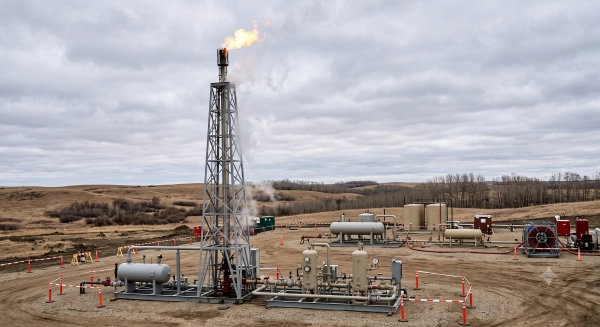
Flare stacks are a vertical or ground-level device that safely burns the flammable gas in a controlled manner when the process can’t use or store it. Facilities route gas to the flare stack systems during upsets, start-up, shutdown, or routine depressurizing, so pressure in vessels and lines remains within safe limits. In certain facilities, operators employ gas flares to manage biogas from landfills or sewage sludge digesters, wherein the flare combusts methane that cannot be feasibly captured.
The system typically has upstream knockout drums to eliminate liquids prior to the gas reaching the flame, so combustion remains stable and smokeless as long as possible. At the top, the flare tip defines the flame and enhances gas-air mixing. It could be a basic pipe flare, a sonic tip when upstream pressure is greater than around 5 bar, a multi-nozzle design that is sonic or subsonic
A pilot flame, with its own dependable ignition, burns constantly so any gas delivered to the tip ignites immediately. Operators frequently employ a small purge gas flow to sweep the stack and prevent air ingress, which prevents flashback and internal explosions. Most stacks contain a flashback prevention section at the top of the stack and flame arrestors at strategic locations to prevent a flame front traveling back into upstream pipework.
Ground flares put the burners in a steel box or cylinder lined with refractory bricks or castable material to shroud the flame and reduce thermal radiation and noise, which is convenient near population centers. In virtually all designs, the flare stack height or flare boom reach is determined by how much thermal radiation personnel and equipment can safely tolerate at grade or on adjacent structures. Across refineries, gas plants, chemical units and wastewater sites, flare systems serve as a last safety barrier and as a means of remaining compliant with environmental regulations, including those for open and enclosed gas flares for biogas.
The Test Separator
A test separator is a pressure vessel that segregates a well stream into gas, oil, and water so that each phase can be measured individually. It is common during well tests, early production, or even regular allocation checks when operators want to know exactly how one well is doing instead of just working with combined production numbers for a group of wells.
Within the vessel, inlet deflectors decelerate and disperse the flow, mist eliminators and coalescers assist fine droplets to coalesce and drop out, and pressure regulators maintain a steady operating pressure appropriate to the fluid and gas volume. Sight glasses, sample points, and level instruments provide a clear visual of phase separation and enable operators to extract fluid samples for laboratory analysis.
From these measurements, the test separator provides gas flow rate, oil rate, water rate, water cut, and frequently some fundamental fluid properties such as density or gas-oil ratio. This information feeds into reservoir models, production forecasts, and artificial-lift, workover, and surface-facility-sizing decisions.
These units operate in both onshore and offshore fields, in permanent test bays or as skid-mounted packages mobilized for short campaigns. In each instance, the secret lies in selecting a separator size, pressure rating, and internals that are appropriate for the well’s flow regime, anticipated sand or solids content, and the operator’s objectives for precision and granularity of sampling.
Flare Stacks vs Test Separators
Flare stacks and test separators both lie in the same process line. One centers on safe gas disposal, the other on fluid-level detailed measurement that informs long-term production plans.
| Aspect | Flare Stack | Test Separator |
|---|---|---|
| Core purpose | Burn excess / waste gas to remove safety hazards | Separate and measure gas, oil, and water from a well |
| Use pattern | Emergency, upset, pressure relief, limited routine use | Routine or campaign well testing and production optimization |
| Main outcome | Safe combustion, controlled emissions | Accurate phase rates, fluid properties, allocation and reservoir data |
| Operation | High‑temperature, open flame, often intermittent | Pressurized vessel, controlled flows, continuous instrumentation |
| Data output | Basic flare rates, combustion efficiency, emissions | Detailed volumes, flow rates, PVT data, water cut, GOR |
1. Purpose
Flare stacks are there to protect personnel, equipment, and the site. They incinerate excess or waste gases so they do not accumulate and create an explosion or toxic cloud in the plant or around the wellhead. In most plants, any emergency shutdown or quick overpressure directs gas to the flare, frequently through a flare knockout drum that removes liquids first so they do not reach the flame. The stack height is such that the heat and radiation from that flame are contained within acceptable limits for workers and nearby equipment, which is why many flares are tall and constructed with high-temperature, high-pressure materials.
Test separators do something else. They separate the well stream into gas, oil, and water and then measure each phase so the operator knows how the well is truly performing. They can be sized for low rate appraisal wells or high rate production wells and can operate over a wide range of pressures and flow rates. Test separator data powers production allocation, reservoir models, and artificial lift and chemical dosing decisions.
In an ideal workflow, flare stacks assist emergencies and upset cases, while test separators assist routine well testing and optimization. When planning a project, it helps to ask a simple question: is the main goal to remove a safety hazard, or to gather reliable data for long-term planning? That answer leads to flare, test separator, or both.
2. Data
From a data perspective, flare systems are very lean. They typically offer flow or approximate mass rate to the flare, some simple combustion efficiency checks, and emission readings for CO₂ and NOₓ. Many plants monitor flare volumes over time for regulatory purposes. This information tells little about individual well performance.
Test separators are data engines. They measure gas, oil, and water volumes, phase flows, and can connect to instruments that monitor pressure, temperature, density, and even composition. A simple chart often helps: flare equals safety and emissions metrics, test separator equals full well performance picture. Since choke settings, lift gas, and workover decisions rely on this data, instrumentation on test separators must be closely calibrated and frequently checked. Without that, production models drift and so do forecasts.
3. Safety
Flare stacks are the last safety net for gas. In situations such as overpressure, blocked-in lines, or fast depressurization, gas flows to the flare where it can burn in a controlled way rather than vent raw to the air. A good flare system has a knockout drum, flame arrestors, pilots, and automatic ignition systems to keep the flame where it belongs and prevent flashback.
Test separators don’t provide safety in that sense either, but they contribute to safe operation. They allow operators to manage high-energy well fluids within a rated vessel rather than impromptu routing to open tanks or lines. That controlled separation and steady pressure control reduce the risk of sudden releases. Both flare and separator packages should have pressure relief, automatic shutdown, and clear operating limits. Poor maintenance, bypassed alarms or blocked drains can make either unit a hazard instead of a safety measure.
4. Environment
Flaring converts hydrocarbons into combustion products, including CO₂, water vapor, and, if burning is incomplete, soot and other pollutants. Visible flames and noise may raise community concerns. For that reason, a lot of facilities are eager to reduce regular flaring and reserve it mostly for safety. Tip design matters here. Pipe flares, sonic tips, multi-nozzle tips, and Coandă tips all try to mix gas and air better to achieve a more complete, smokeless burn.
Test separators assist by utilizing produced fluids more effectively. Instead of flaring all gas, operators can direct metered gas and liquids into sales, reinjection, or fuel flows. This reduces unnecessary fuel burn and aids stricter emissions goals. In many jurisdictions, both flare systems and separation trains are subject to rules regarding emissions, monitoring, and reporting. Smokeless flaring systems and vapor recovery units frequently get folded into the plan for compliance, not a nice-to-have add-on.
5. Economics
Flare stacks may appear straightforward, but the total system cost includes the stack, knockout drum, pilots, ignition, piping, and continuous testing on materials that endure high temperature and pressure. Operating costs include pilot fuel, utilities, and any regulatory fees or penalties associated with flared volumes and emissions.
Test separators tend to be more expensive up front. The vessel, control valves, meters and high-precision gauges increase capital and maintenance costs, and instruments need to be calibrated on a regular basis. In return, a good test program leads to better reservoir management, lower uncertainty on reserves and higher recovery, which can generate lots more revenue than the test package costs.
When it comes to the two, it usually involves a total life-cycle view. Flare stacks keep the plant safe and compliant, while test separators protect cash flow by translating raw wellstream data into crystal-clear numbers. Both are required, but under-investing in either one has a way of surfacing later as lost barrels, increased emissions, or both.
Choosing Your Equipment
Decision of flare stack versus test separator begins with transparent understanding of testing objectives, the fluids in the well, and practical constraints on location including space, power and crew capabilities. It requires a careful review of gas composition, anticipated flow rates, and what local regulations permit or prohibit. A straightforward decision matrix or checklist that scores safety, data quality, and cost side by side often helps teams pick a setup that fits the field — not the other way around. For numerous projects, partnering with a reliable equipment vendor who understands both systems eliminates guesswork and helps to keep the design in compliance.
When to Flare
Flaring is most typical when gas cannot be safely and rapidly utilized, stored, or transported to a pipeline. Typical cases are emergency shutdowns, blowdown through upset processes, and short-term disposal of low-value or off-spec gas. Portable flare stacks can accommodate drilling or shorter campaigns, and permanent elevated stacks, sometimes more than 30 meters high, can serve large processing sites.
Most laws and codes mandate a flare wherever there is a potential for over-pressure or toxic gas release. Rules might specify a minimum of 98% combustion efficiency, quarterly or annual emissions reporting, and limits on visible smoke or noise, so the design has to suit the gas stream and the reporting schedule.
Good practice is to tune assist gas, steam, or air so the flame is stable and smokeless while still hitting target efficiency. Newer flares frequently incorporate valves that reduce pilot gas consumption, prevent unnecessary flaring, and connect to gas-recovery systems that capture usable gas before it even reaches the tip.
Dependability lies in consistent monitoring. Operators will often schedule quarterly visual inspections from the ground, in addition to annual thermal imaging to identify hot spots and ultrasonic testing on critical welds and piping. This ritual typically costs a lot less than meltdown failure.
When to Separate
Test separator packages are important when you’re after the data, not just safe disposal. They’re utilized in single well tests, production allocation between several wells on a common line and reservoir studies where engineers require unblemished trends on water cut, gas-oil ratio and sand load.
A properly sized separator provides discrete, steady streams of oil, gas, and water, enabling precise metering and uncontaminated fluid samples. That’s important for contract reporting and Alberta natural gas royalty reporting, quarterly or annual reserves updates, and populating surface and subsurface models that drive long-term field plans.
Teams commonly employ test separators for new well start-ups, flowback after stimulation, and targeted production optimization efforts. At those phases, live measurements assist in selecting choke sizes, configuring synthetic rates, and identifying points reminiscent of early water or scale.
Sizing and setup must match pressure, temperature, expected turn-down range, and any solids. Partnering with vendors to select horizontal versus vertical vessels and the number of phases and internals helps keep measurements in spec while still being easy for crews to operate.
Hybrid Approaches
Most projects benefit from having both a test separator and flare in one integrated package, particularly for high-rate or sour wells. The separator manages phase splits and metering. The flare accepts excess gas, unstable surges, or off-spec streams that cannot be sold or reinjected.
In unstable flow, operators can route base gas volume to a gas line or recovery unit and divert only peaks or upset gas to an elevated flare. Others tack on smokeless flare tips and gas-recovery packages that pull back some of the stream prior to burning, reducing emissions and fuel consumption while still maintaining pressure relief.
Control and safety systems must be able to “see” both units as a single process. Shared pressure and level alarms, linked shutdown valves, and common logic for high-pressure or high-temperature trips prevent gaps with one unit operating and the other one struggling. Data links from flowmeters, flare gas meters and emission monitors facilitate accurate quarterly or annual reports to regulators and partners.
Beyond the Basics
Beyond comparing general function, flare stacks and test separators begin to differ in how they integrate into digital systems, comply with regulations, and withstand aging. Choices now extend to automation, data quality, and long-term environmental impact, not just safe disposal or clean measurement.
Regulatory Landscape
Regulation for flare stacks is usually focused on emissions, combustion efficiency, and safety performance. Most regulations include high hydrocarbon destruction and removal efficiency, minimum combustion efficiency targets, and confirmed pilots and ignition operation. Thermal radiation limits guide design: stack height and boom reach are set so people and equipment stay below set radiation levels. For constant exposure with standard mill attire, 1.58 kW/m² is an upper limit, 4.73 kW/m² is permitted for just 3 to 4 minutes, and 6.31 kW/m² for about half a minute.
Test separators are covered by standards for metering, calibration intervals and data reporting. Regulators and partners often anticipate traceable calibrations for flow, pressure, temperature and phase measurements, along with explicit uncertainty ranges. Where emissions reporting is rigorous, inferred flare volumes from test separators need to correspond with greenhouse gas accounting principles.
Both systems rely on strong documentation: calibration sheets, maintenance logs, operator training records, and change management files. Evolving greenhouse gas regulations crank it up even more. Flaring emits carbon dioxide and other gases, with methane’s global warming potential approximately 28 to 36 times that of carbon dioxide over 100 years. With approximately 150 billion cubic meters of associated gas flared annually worldwide until 2020, which is roughly 25 percent of annual US gas consumption, regulators and investors increasingly incentivize configurations that reduce flaring or enhance capture. This, in turn, drives the design of new flare tips and more accurate test separators.
Maintenance Demands
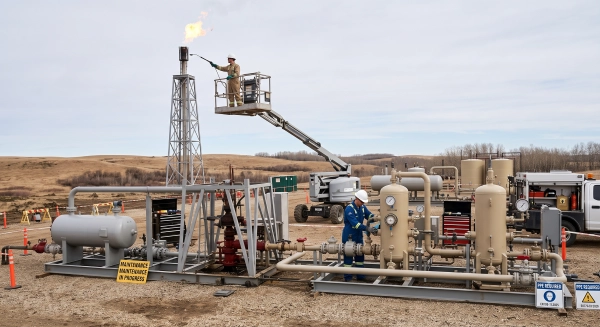
Test separators require other habits. Crews scavenge hulls for barnacles to uninstall scale, sand, and wax that distort phase separation. Instruments, including pressure transmitters, temperature elements, level controllers, and flow meters, should be calibrated periodically against known standards. Valves, flanges, and sample points should be checked for safety and measured for rate-affecting leaks.
Preventive work slashes unplanned trips and missing data. For numerous sites, unplanned downtime on a test separator signifies lost production allocation data. A faulty flare lighting could cause emergency shutdowns or regulatory incidents. Digital maintenance systems can assist in tracking intervals and connecting observations back to training.
Simple checklist, often built into a computerized maintenance system, can keep teams aligned:
- Flare stacks: Inspect structure and access, verify pilot gas supply, test ignition and flame detection, inspect and clean tip, drain and clean knockout drum, check purge and seals, review radiation and exclusion zones.
- Test separators: check vessel internals, clean strainers, calibrate pressure, temperature, level, and flow instruments, test safety valves, perform leak checks, and verify data logging and communication.
Technological Advances
Modern flare stacks employ more advanced hardware and control. Smokeless burners, better flare tip materials and innovative tip designs, such as simple pipe, sonic, multi-nozzle and Coandă tips, are intended to increase combustion efficiency and reduce visible smoke. A Coandă tip utilizes the Coandă effect to suck in more air, which makes the flame hotter and cleaner. Ground flares position burners within a refractory-lined box or cylinder to obscure the flame, decrease noise and reduce radiation at grade. This assists in achieving stringent site limits without the need for very tall stacks. Automated ignition and real-time digital monitoring track pilot condition, flame stability, and even tip health.
On the test separator side, instrumentation and data tools have raced ahead. High frequency multiphase meters, smart pressure and temperature transmitters, and advanced level controls enhance phase split and rate accuracy. Remote monitoring enables engineers to analyze trends, alarms, and test quality from centralized rooms or remote offices, which can be critical on offshore or remote land assets. Portable and modular test separators provide operators flexibility to shift capacity from well to well or pad to pad as demand changes.
Across the board, investment in automation, online diagnostics, and better analytics can lift safety, cut emissions, and sharpen production decisions. Teams who incorporate periodic technology reviews and case study analysis and maintain operator skills as part of their routine are more well-positioned to align equipment decisions with their long-term field objectives.
An Operator’s Perspective
Operators treat flare stacks and test separators as connected systems, not independent devices. The day to day concerns are safety, clean data, and keeping the plant running while staying inside tight environmental rules.
The Human Factor
Safe, efficient operation always comes down to people — in the control room and on the pad. Experienced operators must know how flare headers, knock-out drums and pilots connect to well test separators and lines further downstream. They have to choose the right separator setup for the job: 2-phase units when they only need to split gas from total liquids, and 3-phase units when they must measure gas, oil, and water separately for allocation or reservoir studies.
Training can’t be a one‑shot course. Teams need defined drills on start‑up, shutdown, high‑rate well tests and upset cases where flaring escalates rapidly. That covers how to respond when flare combustion efficiency falls under thresholds like the usual 98% mandate or when test separator levels fluctuate and impact measurement integrity.
Human error shows up in simple ways: wrong valve line-up, skipped checks on flare pilots, or missing a small drift in separator pressure or interface levels. These little slippages can result in bad test data, incorrect production numbers, and in nightmare scenarios, unsafe flaring or loss of containment.
A strong safety culture goes a long way in mitigating these dangers. That means written procedures that human beings actually follow, peer review on life-or-death steps, and managers who regard near-miss reports and operator comments like fuel for improvement, not fodder for fault-finding.
Hidden Costs
Flare stacks appear to be sunk cost. They actually have continuing expenditures. Bad tuning can blow more purge gas than necessary, waste precious hydrocarbons and spark excess emission fees or fines. If they don’t burn it all, they’re on the hook for environmental liabilities from smoke, noise and complaints from neighbors.
Test separators conceal their own expenses. Calibration drift on pressure, temperature, or multiphase meters can bias rates for weeks and then necessitate retesting or reallocation efforts. Slow maintenance or clogged dump valves can cause unplanned downtime during a key well test window, so rigs or intervention teams sit idle.
Budget schemes should have a dedicated line for inspections, spare pilots, flame scanners, valves, level controllers, and analyzer maintenance on both flare and separator equipment. Quarterly or at least annual proactive inspections commonly cost less than one unplanned shutdown associated with a stuck control valve or failed flare ignition.
Some easy cost-tracking tools assist. Even a rudimentary dashboard that captures fuel gas consumption, flare volumes, separator downtime hours and replacement parts can highlight trends and justify upgrade funding, such as better seals or pilot systems.
Future-Proofing
Future-proof operation means preparing for stricter regulations, greater throughput, and increased digitization. Operator’s Perspective Flares have to keep up with changing environmental standards, which include increasingly stringent proof of 98% combustion efficiency and reduced visible emissions. Test separators are facing changing fluid mixes, increased water cuts, and new well types. Modular designs help. A 2-phase separator might work early in a field, then a 3-phase package can be added or swapped in when the precise oil-water split becomes critical for allocation or water-handling design.
Digital integration provides operators with a more transparent view of both systems. Remote monitoring can stream 24/7 data on flare temperature, pilot status, and gas rates, while test separator data feeds real-time dashboards for flow, water cut, and pressure. With predictive analytics, teams can identify fouling, valve wear, or pilot instability patterns before they become trips or visible flaring. Modern flare systems now incorporate smokeless tips and gas recovery units to reduce harmful byproducts and capture usable gas, which enables both compliance and operating cost management.
Building those strong, long-term relationships with equipment vendors and service partners matters. Trusted partners can back upgrades, tune sophisticated combustion systems, assist in documenting emissions performance, and keep test packages in sync with new measurement or reporting rules.
Optimizing Your Well Test
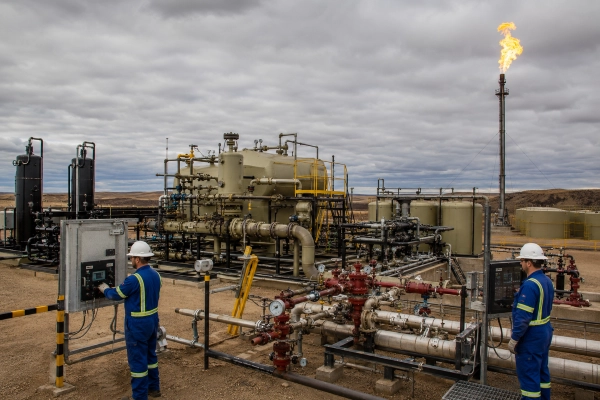
We know optimizing your well test means gathering reliable reservoir data while remaining safe, compliant, and on schedule. That begins with how flare stacks and test separators integrate into the entire spread of equipment on site, ranging from sand filters and cyclone desanders to three-phase separators, heater exchangers, choke manifolds, LP separators, surge tanks, KO vessels, and flare stacks or clean enclosed burners for ultimate disposal.
Best practice is to route reservoir fluids to holding tanks until test staff observe drilling fluids and other contaminants decrease to an acceptable level in the flow stream. During this period, test separators do the heavy lifting. They split water, oil, and gas, measure each phase, and log rates so you can back out production potential, skin, and even absolute open flow (AOF). A good phase split is key, so the separation train should be sized and staged. Sand filters and cyclone desanders are up front to protect the three-phase separator, then LP separators or surge tanks are downstream to smooth slugs before anything reaches the flare or enclosed burner.
On the combustion side, tailor the flare stack or enclosed burner to anticipated gas rate, pressure, and H₂S content. Utilize KO vessels for stripping liquids and maintain pilot, ignition, and smokeless tips, supported by reliable burner management systems, for emissions and safety compliance. For certain assets, wireline formation testers can reduce long flow periods by taking multiple downhole samples in a single trip and then reserving surface well tests only when you require full-rate performance or longer-term reservoir evaluation, which can span less than two days to a few months.
SOPs help keep this all under control. Develop well-defined SOPs and checklists for setup, operation, and shutdown of separators, tanks, flares, burner systems, PSV/PRVs, pressure pilots, high and low level switches, and ESD. Analyze test data, shutdown events, and equipment performance after every campaign, then feed what you learn back into your programs. A rental and wellsite support partner in Alberta that provides flare stacks, test separators, and fit-for-purpose safety systems can assist in bringing field practice into alignment with Alberta’s land conservation and reclamation guidelines and other prevailing standards and local regulations.
Conclusion
Flare stacks vs test separators flare stacks and test separators do very different jobs. They connect closely in oil well testing. Flare stacks burn gas you cannot use on site. Test separators provide clear oil, gas, and water rates so teams can evaluate a well with actual metrics.
Good setups couple gear to the well, the field regulations, and the safety requirements. Good crews monitor trim, vent, and fluid rates in real time. That combination reduces hazards, conserves fuel gas, and maintains accurate data.
For your next well test plan, consider both tools side by side. Map out what you need from each. Then work with your team to lock in a setup that fits your field.
Frequently Asked Questions
What is the main difference between a flare stack and a test separator?
A flare stack combusts surplus or waste gas. A test separator physically separates oil, gas, water, and sometimes solids for measurement. The flare is for safe disposal.
The test separator is for information, allocation, and production efficiency.
When should I use a flare stack during well testing?
Use flare stacks when you need to safely dispose of gas during flowback or testing. It deals with unstable, sour, or high-pressure gas. It safeguards personnel, equipment, and the environment by managing combustion and dispersion.
Why is a test separator critical for well performance evaluation?
A test separator provides precise phase rates and pressures. These measurements feed reservoir models, production forecasts, and facility design. Without a test separator, you’re just guessing on well performance instead of having hard data.
Can a flare stack replace a test separator?
No. A flare stack can’t measure or separate phases. It just incinerates gas or liquids for safe disposal. You still require a test separator for flow measurement, allocation, and regulatory reporting.
How do I choose between a two-phase and three-phase test separator?
Go with test separators for your fluid. If water production is low or insignificant, then a two-phase unit will suffice. If water rates impact flow, corrosion or disposal design, deploy a three-phase separator for more accurate data.
What safety factors matter most when sizing a flare stack?
Key considerations are maximum flow rate, gas composition, pressure, and heating value. You need to factor in radiation limits, noise, and safe distance from individuals and equipment. Right sizing keeps flashback, excessive noise, and heat damage to a minimum.
How can I optimize my well test using both flare stacks and test separators?
Use the test separator for accurate phase rates and pressures. Handle variable gas safely with the flare stack. Align both with your test plan, data requirements, and regulatory thresholds. This equilibrium provides consistent information and secure effective processing.